1 hour ago
2
1 hour ago
2

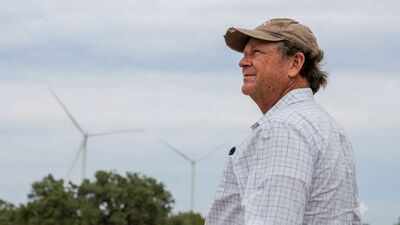
John E. Davis (AI enhanced scereengrab- Youtube/KC Videoclub)
A fifth-generation West Texas rancher twice rejected plans to put wind turbines on his family’s property before eventually agreeing to host seven turbines. Today, the wind project has become an important source of regular income for John E Davis, helping him continue his ranching operation and invest in other projects in the community.Davis, a former Texas state representative and former chair of the House Economic and Small Business Development Committee, owns the ranch with his brother, Keith Davis. The property is near the Concho County-Menard County line. The family was first approached about the wind project in 2016, but Davis said they did not want “any of those ugly old wind turbines” on their land, Texas Energy and Power.com reported.The developers returned about a year and a half later. The brothers rejected the proposal again before eventually agreeing to join the Cactus Flats wind project in Concho County.
Developed by RES, the Cactus Flats Wind Facility has a capacity of 148 MW and includes 43 turbines. Seven of them are now on the Davis family property.The turbines began going up in 2018 and started generating income for the ranch in 2019. Davis said the regular payments have helped him continue operating the ranch. He also described the wind revenue as “a lifeline for us”.
Why Davis changed his mind
The decision eventually came down to the need for a stable source of income from the ranch.
Davis said his brother negotiated a contract that included minimum royalty payments, with the payments adjusted upwards every five years.The family also discussed the proposal with Davis’s father, who had worked for Shell Oil and was involved in land and right-of-way work. Davis recalled that his father asked, “Well, does it pay any money?” When Davis told him that it did, his father agreed to the idea.The wind payments became important as the ranch dealt with changing livestock prices, drought and rising feed costs.
Davis raises sheep, goats and cattle, including Wagyu cattle, Rambouillet sheep and Angora goats.The regular income helps pay for ranch workers, animal feed, fences, water equipment and repairs. While livestock income can rise and fall with market conditions, the wind lease provides a more predictable source of money.Davis also recalled what happened when the first payment arrived. His wife, Jane, received half of the income because they were married.
She initially offered the cheque back because the land had come from Davis’s family. Davis told her, “give to Jane Davis what is Jane Davis’s.”He said she now receives an automatic payment every three months. Her response, he recalled, is, “Thank you very much” and “John, keep ranching.”
Ranching continues under the turbines
The wind project did not replace the family’s ranching operation. Davis continues to raise animals on the property, including about 200 nanny goats, 200 Dorper ewes and around 30 cows.The project also improved access around the ranch. Davis said travelling from the entrance to the top of the property once took about 25 minutes because of the rocky ground. After roads were built for the turbines, he said the same journey takes about three and a half minutes.The turbines have also become part of everyday life for the animals. During summer, Davis said sheep can be seen resting in the shade cast by the turbines.Davis rejected claims that the turbines had made the property unsuitable for hunting or livestock. He said his hunting income had not been affected and that he had not seen dead birds around the turbines.The turbine income has also given Davis financial flexibility to invest in another project in Menard, Texas. He developed a two-acre site on a former Exxon property into what he calls the Menard station. The site includes an EV charging station, livestock, a music stage, a farm stand and a book exchange.The site also sells products such as farm eggs and is being developed to include a beer garden and Wagyu beef products. Davis said he plans to sell Wagyu franks and bratwurst and hold live music events.
A question of rural property rights
Davis, who identifies as a conservative Republican, said landowners should be able to decide whether to host wind, solar or other energy infrastructure on their property.He argued that renewable energy should not automatically be treated as a political issue.
In his view, using wind and sunlight available on rural land can give landowners another way to keep their operations running.He said opposition to renewable energy can hurt rural landowners who depend on different income sources to maintain working ranches.Davis described the issue as one of private property rights. “It’s private property rights. It’s our land. It’s mine. It’s a way to get grit, to use the land to support your family, support your next generation,” he said.He also argued that energy development can benefit rural communities through roads, tax revenue and other economic activity.