55 minutes ago
3
55 minutes ago
3

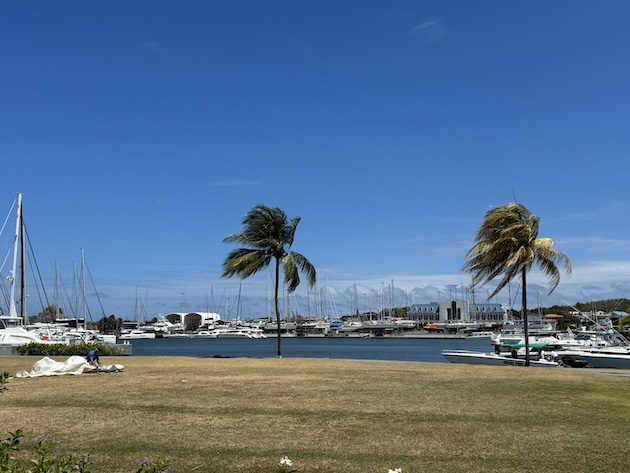 Rodney Bay Marina, Saint Lucia. Rising seas are among the mounting risks for small island states as the world heads towards an expected overshoot of 1.5°C. Credit: Alison Kentish/IPS
CASTRIES, Saint Lucia, September 8 (IPS) - The world is now expected to breach the 1.5 degrees Celsius warming limit that small island states have spent years defending as a threshold for survival.
For people in the Caribbean, Pacific and Indian Ocean, the consequences will not begin only when islands disappear beneath the sea. They include saltwater intrusion into freshwater supplies and agricultural land, coral reef loss, more damaging coastal flooding and mounting pressure on already limited resources for recovery and adaptation.
That is the stark warning emerging from the United Nations Environment Programme’s Limiting Overshoot report, launched on September 2. The report examines a future in which average global temperatures rise beyond 1.5°C above pre-industrial levels before, potentially, being brought back down.
The report concludes that the world is now expected to cross the 1.5°C threshold. What is still uncertain is how far above it temperatures will rise, how long they will remain there and how quickly they can eventually be brought back down.
Dr Shobha Maharaj, a Caribbean scientist and one of the lead authors of the report’s Chapter Four, says the expected breach raises a new set of questions for small island states.
“For years, the goal was to avoid crossing 1.5°C. But this report now says very clearly that we are going to cross it,” she said. “The question now is how deep is this overshoot going to go? How long is it going to last? And how do we live through it while we work to bring temperatures back down to 1.5°C?”
No buffer
The Paris Agreement committed countries to pursue efforts to limit warming to 1.5°C. Small island states were among the strongest advocates for the 1.5°C target, arguing that higher levels of warming would pose an existential threat.
“For small islands, it is because we live closest to the thresholds,” Maharaj said. “In a wealthy, temperate country, an additional half-degree of warming would still carry serious costs. But on a small island, it could determine whether a reef recovers or not, or whether an aquifer stays fresh or turns salty for good.”
“There is no higher ground to move to, no deep treasury to draw on and no second reef when one of them dies,” she added.
The danger is not limited to dramatic disasters, she said. Habitability can erode quietly.
“Saltwater can contaminate groundwater and soil. A kitchen garden that has fed a family for generations may stop producing. High tides can reach roads, homes and public infrastructure even on clear days. When reefs die, communities lose not only fish and tourism income but also natural barriers that weaken waves before they reach the shore.”
“None of this requires an island to vanish,” Maharaj said. “Habitability begins to collapse first, quietly, through water, food and the loss of the everyday things that make a place home. By the time submergence becomes the headline, people have often already been forced to leave.”
The report warns that sea-level rise will continue for centuries and that falling global temperatures would not reverse all the damage accumulated during overshoot. Some ecosystem, biodiversity and glacier losses would persist, meaning a return to 1.5°C would not restore the world that existed before the threshold was crossed.
Small Islands, Different Realities
SIDS are often discussed as a single group, but Maharaj cautioned that their circumstances and options differ.
Pacific atoll states face acute threats because of their extremely low elevation and vulnerable freshwater lenses. Some Pacific islands are also experiencing land subsidence, compounding the effects of rising seas.
Several Caribbean states have higher terrain, but much of their population, infrastructure and economic activity is concentrated along narrow coastal areas. Indian Ocean states face their own combination of risks.
“What we share is a structural predicament, narrow room for retreat, limited finances and economies that are exposed to single shocks,” Maharaj said.
But she warned against transferring solutions indiscriminately between regions.
“The right response in Tuvalu, for example, is not automatically the right response in Barbados or the Maldives.”
Adaptation Buys Time, Not Immunity
For decades, adaptation has been presented as the principal defence for countries already living with climate impacts. But the UNEP report says many existing approaches were designed for gradual, one-directional warming, not temperatures that rise, plateau and may eventually decline.
Strategies fixed to one set of conditions could become ineffective or even increase vulnerability as conditions change. The report calls instead for adaptation that is flexible, forward-looking and capable of evolving throughout the different stages of overshoot.
“Adaptation buys time, not immunity,” Maharaj said.
She said the large gap between adaptation planning and implementation may provide a narrow opportunity to revise projects before they are built for conditions they can no longer withstand.
“We have a lot of plans, but many of them have not yet been implemented,” she said. “That gives us a window, although not a large one, to recalibrate those plans for a post-1.5°C world.”
That shift will require money before disasters strike.
Many developing countries are already trying to adapt, recover from extreme events, transform their economies and reduce emissions while servicing heavy debt. Climate finance, Maharaj said, arrives too slowly and is often supplied through loans that add to that burden.
“A disaster drains public funds into emergency response and reconstruction. That leaves less money to reduce the risks posed by the next event, which then hits a weakened country even harder. Each turn of that wheel reduces the very capacity we need to climb out of it.”
Breaking the cycle will require grants, upfront financing and investment in prevention, rather than repeatedly paying to rebuild after losses.
A Deeper Injustice
Overshoot also raises questions of climate justice, particularly for countries with little historical responsibility for the emissions driving warming.
“The harms concentrated during this period, especially those that turn out to be irreversible, fall hardest on the countries least responsible for the emissions that caused them,” Maharaj said.
Maharaj said contributing to the report carried a particular weight for her as a Caribbean scientist.
“For those of us from these islands, 1.5°C was never simply a number on a chart. It was the line we were told represented survival. It was the line at which we were told survival was still possible,” she said. “Now, helping to write the science of what lies beyond that line is a heavy thing, both personally and professionally.”
Crossing 1.5°C, she said, represents “a profound failure of collective will” but not permission to give up.
“How high the peak rises, how long we remain there and how quickly temperatures are brought back down are all still ours to decide,” Maharaj said. “Every one of those choices will be measured in lives and livelihoods here in our region and across small islands.”
For small islands, limiting the overshoot could mean the difference between mounting losses and holding on to the places people call home.
IPS UN Bureau Report



© Inter Press Service (20260908065216) — All Rights Reserved. Original source: Inter Press Service