
 4 months ago
48
4 months ago
48


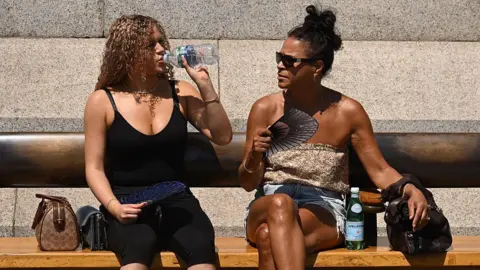 AFP via Getty Images
UV levels are unusually high across much of the UK for this time of year.
Some exposure to UV is essential for our wellbeing, but too much is damaging and can cause skin cancer.
What is UV and why can it be dangerous?
UV radiation is emitted by the Sun and penetrates the Earth's atmosphere.
It enables our skin to produce essential vitamin D, which is important for the function of bones, blood cells and our immune system.
But too much UV can be harmful.
It can lead to skin cancer by damaging DNA in skin cells. UV also plays a substantial role in skin ageing, contributing to wrinkles and loosened folds.
It has also been linked to eye problems, including cataracts.
"Every exposure to UV, especially every sunburn, increases our risk of skin cancer," says Prof Dorothy Bennett, from St George's, University of London.
"Melanoma, the most dangerous skin cancer, is now the fifth commonest cancer in the UK."
How is UV measured and what is the UV index?
Levels of UV radiation vary throughout the day.
The highest readings are in the four-hour period around "solar noon", when the sun is at its highest - usually from late morning to early afternoon.
The UV Index (or UVI) is a measure of ultraviolet radiation used around the world.
Values start at zero and can rise above 10.
The higher the number, the greater the potential for damage to the skin and eyes, and the less time it takes for harm to occur.
What do the different UV levels mean?
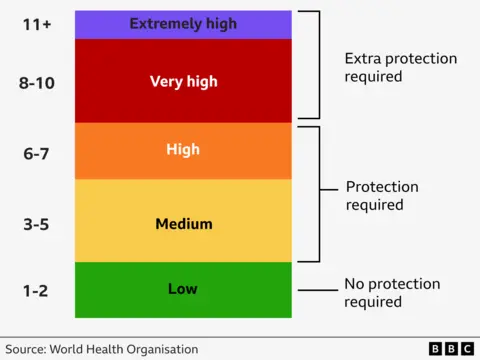
In the UK, the UV index would typically be around 5-6 during the summer, with a maximum of 8 only in exceptional circumstances.
Countries close to the equator can experience very high UV levels in the middle of the day, throughout the year.
Nairobi in Kenya, for example, can have UV levels above 10 all year, according to the World Health Organization (WHO).
Majorca in Spain normally hits nine in June and July.
How can you protect yourself from UV radiation?
Appropriate sunscreen is essential.
Some sun protection is required when UK levels are medium (3-5) or high (6-7), the WHO says.
Extra sun protection is required when UV levels are very high (8-10) or extremely high (11+).
Children are more sensitive to UV radiation than adults, and therefore require additional protection at lower levels than adults.
The NHS advises using sunscreen with an SPF factor of 30 or above and which offers at least 4-star UVA protection.
It should be applied to all exposed skin, including the face, neck and ears - and head if you have thinning or no hair - ideally 30 minutes before you go out into the sun.
As a guide, adults should aim to apply about six to eight teaspoons of sunscreen if covering the entire body.
It should be reapplied every two hours, or sooner if you sweat a lot, have been in water, or after drying yourself with a towel.
In addition, the NHS recommends:
- covering up with suitable clothing and wearing sunglasses
- spending time in the shade when the sun is strongest - between 11:00 and 15:00 from March to October in the UK
Dr Bav Shergill from the British Association of Dermatologists recommends using self-tan products instead.
"When you tan, ultraviolet light stimulates your skin cells to produce pigment to try and protect the DNA of skin cells - but that protection is minimal - the equivalent of SP4.
"That is not much protection at all - so you can still burn very early," he warns.
Can you burn even when it is cloudy and windy?
The amount of UV reaching your skin is not driven by the daily temperature.
"Your skin can burn just as quickly whether it's 30C or 20C," warns BBC Weather's BBC Weather's Helen Willetts.
"Don't be caught out on cloudy days. UV will still penetrate thin clouds - so even if you don't think it's that sunny, you can still burn."
I have brown skin. Do I need to worry?
Yes, according to Dr Shergill.
"The skin may look darker, but it doesn’t always behave that way from a protection point of view – because there are more genes at play than we think about," he says.
"I have, for example, seen South Asian people with skin cancer and I have seen people with dual-heritage get skin cancer."
The broader risks of eye damage and harmful effects on the immune system from too much UV radiation affect people of all skin colour.


