1 hour ago
4
1 hour ago
4

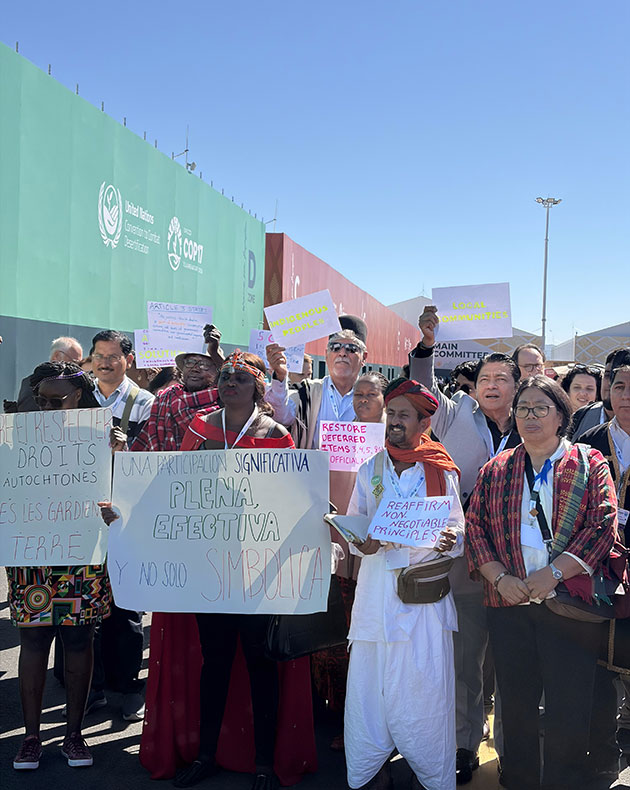 Indigenous Peoples, local communities, and Afro-descendant Peoples protest exclusion and lack of recognition at the UNCCD COP17 in Ulaanbaatar, Mongolia. Credit: Lucas Wasson for Rights and Resources Initiative
ULAANBAATAR, Mongolia, September 23 (IPS) - Rightsholders came to Ulaanbaatar from across the world, carrying declarations, demands and years of experience defending the lands on which their communities depend. Indigenous Peoples, local communities, Afro-descendant Peoples, women and youth were equally clear about what they needed from COP17. But being in the room is not the same as having power in the room.
In a year when the International Year of Rangelands and Pastoralists and the three Rio Conventions were supposed to create momentum for rights, recognition and implementation, the negotiations showed how quickly those gains can be diluted when the people concerned are not able to shape the language that governs their lands.
What happened in Ulaanbaatar should concern anyone advancing land restoration, climate resilience and biodiversity conservation. These cannot succeed while the rights of the people who govern these landscapes remain negotiable.
Ahead of COP17, the demands were clear: 2026 could not be a symbolic year. It had to be a year when secure and customary tenure for Indigenous Peoples, local communities, pastoralists, Afro-descendant Peoples, women and youth was translated into real protections and implementation across the Rio Conventions.
Pastoralists, Mobile Peoples, Indigenous Peoples, Afro-descendant Peoples and local communities are proven leaders in land stewardship, biodiversity conservation and climate resilience. Achieving global restoration goals requires recognizing their rights, knowledge and leadership.
Secure and flexible tenure and mobility rights were an urgent ask in the context of the IYRP. RRI’s legal analysis of seven countries found that only Nepal and Niger recognize pastoralists as distinct rightsholders and only Niger considers mobility as a fundamental right. Even where rights exist on paper, they routinely fail against agricultural encroachment, mining, conservation expansion and green energy projects. Tenure should not be secondary to these initiatives, but a pre-condition before any projects are attempted in community lands.
Communities requested land and customary governance rights as a formal and permanent agenda item following past land tenure decisions, with customary institutions recognized as implementing bodies rather than consulted stakeholders and Free, Prior and Informed Consent (FPIC) as a precondition for any Land Degradation Neutrality action.
Finance is not a technical question. It is a question of power. At a COP supposedly focused on implementation, it should have been a central matter that communities cannot implement priorities they did not define, using resources they do not control. Yet too much climate, biodiversity and land finance still travels through institutions far removed from the communities whose territories generate environmental benefits.
For communities, direct and flexible finance is about more than getting money to the last mile. It is about trusting organizations and customary institutions to decide what resilience, restoration and development mean in their own territories.
Rightsholders were ready to advance their distinct rights during COP17. The presence of pastoralists at COP17 was significant, but presence alone does not translate into influence. Pastoralists arrived organized, with a global declaration and clear demands, yet the experience of the negotiations showed that meaningful participation requires more than being present in the conference halls. It requires the knowledge, resources, relationships and sustained capacity to follow negotiating texts, understand procedures, build alliances and influence language as decisions are being shaped.
On Land and People Day, the Indigenous Peoples Caucus delivered the Sacred Lands Declaration directly to the UNCCD Executive Secretary, demanding recognition grounded in self-determination, a permanent seat on the Committee on Science and Technology, and a dedicated fund for Indigenous-led restoration.
The local communities caucus asked for institutional status equal to the Indigenous Peoples’, Gender and Youth Caucuses rather than as a facilitative mechanism sidelined when convenient, plus a self-determined representation model and sustained funding for its operation.
Afro-descendant Peoples asked for what the other two Rio Conventions have already conceded: to be named. Afro-descendant Peoples across Latin America and the Caribbean steward territories degraded or acutely at risk — drylands, deforested frontiers, dry forests, riverine and coastal lands. They asked the UNCCD to open an Afro-descendant desertification agenda for the first time.
Women’s demands cut across all of this. Parties have built agreed gender language across three COPs. The ask was that it hold and be implemented.
For youth, being called “the future” has become another way of postponing their participation in the present. Young rightsholders are already living the consequences of drought, shrinking mobility, changing economies and pressures on their territories. They are not waiting to inherit these challenges. What they need is more than a voice now, it is representation, resources and authority in the institutions making decisions about their future. Their minimum requests included recognition as drivers of present-day adaptation, a permanent space within UNCCD processes, culturally appropriate education, and direct financing for youth-led organizations.
How the Negotiations Went
Based on prior COP decisions, COP17 should have been the continuation of a road towards implementation. Instead, the days in Ulaanbaatar became much more focused on protecting past progress rather than operationalizing it.
The institutional failures began on day one. At the opening plenary on 17 August, only two State Parties objected to agenda items, yet no vote was held and instead the presidency provisionally adopted the agenda. Future Strategic Framework, synergies with other conventions, gender, and participation of civil society were all deferred pending consultation. The COP closed with no decision at all on civil society participation, the Riyadh mandate to bring the Indigenous Peoples’ Caucus and the Local Communities’ Caucus to full Terms of Reference under Decision 5/COP.16 was pushed to COP18, and Rio synergies were removed from all decisions. Gender never reached the negotiation floor; instead, a quiet Gender Caucus convened in Plenary as the agenda block was sustained.
Still, IYRP advocacy proved successful to some extent. Parties agreed to recognize the critical role of pastoralists as stewards of rangeland ecosystems, including the importance of transboundary mobility. However, compromise language was adopted, replacing “traditional knowledge” with “knowledge accumulated by pastoralists” in order to remove wording related to Indigenous Peoples and local communities.
This distinction matters. Pastoralist knowledge is not simply a body of information accumulated over time; it is embedded in living institutions, relationships, territories and systems of customary governance. When knowledge is separated from the peoples and institutions that hold and transmit it, it becomes a technical resource while the rights and authority of its holders remain unrecognized. Draft decisions on land tenure and sand and dust storms also advanced, but only by leaving the naming of rightsholders behind. The lack of language on Indigenous Peoples and local communities was one of the biggest gaps. Many negotiators backed Indigenous Peoples’ and local communities’ rights in plenary, but behind closed doors, agreed to language so general it protects no one in particular. Language proposed replacing references to Indigenous Peoples with “common places” or “common people.” In the land tenure text, “affected areas” was pushed toward “common areas,” a phrase with no grounding in any multilateral mechanism and no obligations attached.
This dilution of language is particularly consequential as pressure on rangelands grows from competing global agendas. Rangelands are increasingly being presented as spaces for carbon sequestration, renewable energy, conservation and large-scale restoration, often without adequately recognizing the pastoralists who already govern and steward these landscapes.
And this is where the politics of rangelands becomes unavoidable.
Rangelands are increasingly being seen as spaces for carbon, renewable energy, conservation and large-scale restoration. The danger is that landscapes already governed and stewarded by pastoralists begin to be treated as empty spaces available for solving someone else’s global environmental problem.
A green transition cannot become a new form of land dispossession.
If pastoralists are displaced in the name of renewable energy, excluded in the name of conservation, or turned into carbon credits in the name of climate action, then changing the colour of development does not change its underlying politics.
Climate, biodiversity and land restoration objectives must not be pursued by treating pastoralist territories as empty spaces or global environmental infrastructure while sidelining the people whose livelihoods, cultures and institutions are rooted in them.
The same principle applies to emerging carbon and other environmental markets. Pastoralist rangelands cannot be reduced to carbon sinks whose value is defined externally while the cumulative ecological, economic and cultural value of pastoralism remains invisible. Any financing or market mechanism operating in these territories must begin with secure tenure, meaningful participation, Free, Prior and Informed Consent (FPIC), and fair recognition of the rights and contributions of pastoralist communities.
Right through the final day, negotiators discussed whether to reference synergies among the Rio Conventions, and whether to include gender at all. These questions were either resolved by adopting ambiguous and broad language that betrays the protection from past COP decisions or by simply delaying any decisions to COP18.
Across every draft negotiating text currently available, rangelands, drought, sand and dust storms, land tenure, Afro-descendant Peoples do not appear at all. Not contested and diluted; simply absent. On the year of the three Rio Conventions, this demonstrates how UNCCD is lagging. CBD Decision 16/6 made the Convention on Biological Diversity the first Rio Convention to name them explicitly and at UNFCCC COP30 they appeared in core negotiating text. The bridge that could have carried that recognition into the UNCCD was the synergies item blocked on day one. These synergies are urgent to deal with the intersections across climate, land degradation and biodiversity conservation.
When it came to drought, the COP also fell short. Decision ICCD/COP(17)/L.15 runs to four operative paragraphs: continue discussions at COP18 with a view to adopting a decision on proactive drought management; make drought a stand-alone agenda item; ask the secretariat and Global Mechanism to keep supporting Parties; and report back. After deferring at COP16 and again here, the working group toward a binding instrument did not materialize; the next window is 2028. In the current text, Indigenous Peoples and local communities appear as people affected by drought and consulted, rather than as rightsholders.
COP17 presented an unprecedented situation in which a small number of Parties blocked key issues from meaningful consideration. There is no Land Degradation Neutrality without human rights, no resilience without gender equality, no sustainable land governance without Indigenous Peoples, Afro-descendant Peoples and local communities.
COP17 also taught us something uncomfortable about participation. It is possible to be visible everywhere at a COP and still have very little influence over what finally enters the negotiating text.
Influence requires preparation. It requires people who understand the Convention, know the procedures, follow the text, build relationships with negotiators, organize across constituencies and remain engaged long after the cameras leave. Pastoralist movements have strong knowledge of their lands and livelihoods. What they need now is equal investment in the political and technical capacity required to defend that knowledge and those rights in global decision-making spaces.
If pastoralists want to shape the next COP, they cannot only prepare declarations. They must prepare negotiators.
What Happens Next
The answer cannot be another declaration.
The remaining COPs of 2026 must turn recognition into implementation. That means three things: name the peoples whose rights are at stake; put resources directly into the hands of their organizations and institutions; and give them meaningful authority over the decisions affecting their territories.
At CBD COP17 and UNFCCC COP31, Indigenous Peoples, Afro-descendant Peoples and local communities must be recognized as rights-holders and implementing partners, not folded into generic “vulnerable groups” language. At UNCCD COP18, the gains made on pastoralists, tenure and customary governance must not be allowed to disappear into vague language.
But the responsibility does not rest with the conventions alone. Pastoralist movements must also build the capacity to influence these processes. The period between COPs must be used to coordinate positions, prepare negotiators, track decisions and negotiating texts, build alliances across the Rio Conventions and engage governments between sessions. Pastoralist organizations need investment not only to attend COPs, but to understand and shape what happens inside them.
COP18 must deliver the adoption of Terms of Reference for the Indigenous Peoples’ and Local Communities’ Caucuses, restore gender and synergies to the agenda, open an Afro-descendant desertification agenda, advance a drought decision with the communities who live its consequences first, and restore the full recognition of traditional knowledge.
Vague language does not merely fail to establish obligations. It blurs the content of rights and leaves earned recognition in a regression limbo.
Naming peoples is the beginning of recognition, not the end of it. Recognition must lead to rights, rights must be backed by institutions and finance, and those institutions must have the authority to shape the decisions that affect their territories.
The peoples who shepherd the vast majority of the world’s lands do not need another symbolic year. They need their names written into the decisions, and their voices, institutions and authority protected long after the COP is over.
Bayarsaikhan Namsrai (Steps Without Borders), Gregoria Jimenez Amaya (CITAFRO/ODECO), Isabel Davila Pereira (Rights and Resources Initiative), Stephen Basele (Pastoralist Goals Foundation)
IPS UN Bureau



© Inter Press Service (20260923050227) — All Rights Reserved. Original source: Inter Press Service