2 months ago
39
2 months ago
39

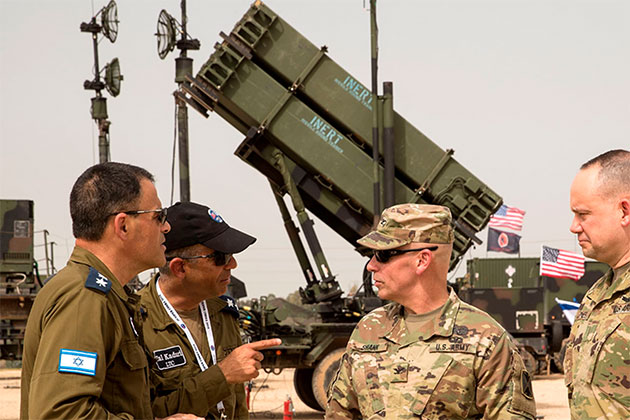 U.S. and Israeli army officers talk in front a US Patriot missile defense system. Credit: Jack Guez/Getty Images Source: Council on Foreign Relations
NEW YORK, July 3 (IPS) - For a generation, no foreign leader bet more heavily on a single American president than Benjamin Netanyahu bet on Donald Trump. Trump moved the US embassy to Jerusalem, tore up the 2015 nuclear accord with Iran, recognized Israeli sovereignty over the Golan Heights, and in February 2026 joined Israel in the opening strikes of a war against Iran that Netanyahu had spent three decades urging Washington to wage.
The partnership looked unbreakable. It was, in fact, conditional—and the condition was that their interests never diverge. In June 2026 they diverged completely, and the rupture has exposed a truth Netanyahu has spent his career denying: when Israeli security and the prime minister’s political survival point in opposite directions, he chooses himself.
The break came over a single document. On June 17, Trump signed a Memorandum of Understanding with Iran—the Islamabad Memorandum, brokered by Pakistan—formally ending the war he had pushed to start. The 14-point framework in the memorandum declares a permanent halt to hostilities on all fronts, including Lebanon, reopens the Strait of Hormuz, lifts the U.S. naval blockade of Iranian ports, and waives sanctions on Iran’s oil exports. It also commits the United States and regional partners to assemble a $300 billion reconstruction fund and to negotiate the gradual release of Iran’s frozen assets worldwide.
What it does not do is what Israel went to war to achieve. The framework deferred the negotiation over Iran’s nuclear program to a later date, and it says nothing about Iran’s ballistic missiles or its regional proxies. Essentially, Trump wanted a short war that would compel Iran to come to the negotiating table. Netanyahu, on the other hand, wanted Iran permanently broken as a regional power. Those two visions could coexist while the fighting continued, but could not survive peace.
Thus, Netanyahu set out to wreck it. Israel’s Finance Minister Bezalel Smotrich branded the agreement bad for Israel and for the free world. National Security Minister Itamar Ben-Gvir declared that Trump’s deal “does not bind us” and that Israel “is not subject to the United States.” And Israeli jets kept hitting Lebanon. On June 14, with the signing supposedly hours away, Israel struck Beirut. Trump erupted publicly, then telephoned Netanyahu.
The call was not diplomatic. In a telephone call by Trump to Netanyahu, he said, ”Bibi, you better be careful, or you will be on your own very soon.” In a subsequent call with Netanyahu, there was an even angrier exchange: Trump called the Israeli leader “crazy,” accused him of ingratitude, and—according to US officials briefed on the call—reminded him bluntly: “You’d be in prison if it weren’t for me.”
That last line is the key to everything. Netanyahu has one political lifeline left: the war. As long as Israel is fighting, there will be no elections; as long as there are no elections, he stays in office, and as long as he stays in office, he can postpone the corruption trials, waiting for the moment he loses power. For Netanyahu, peace is not merely inconvenient—it is politically existential.
The US intelligence community reportedly warned the White House that Netanyahu was actively working to blow up Trump’s Iran deal, and analysts said plainly that Trump would have to play the middle man against his own ally. The man who lobbied for the war had become the chief obstacle to the peace.
Then came the moment the world was meant to absorb. On June 18, Vice President JD Vance stood at a White House podium and delivered a rebuke unlike any an American administration has aimed at Israel in living memory. “Donald J. Trump is the only head of state in the entire world who is sympathetic to the nation of Israel at this moment in time,” he said. “If I was in the cabinet of the Israeli government, I might not be attacking the only powerful ally I have left.”
Then the reminder that doubled as a threat: “Over the last three months, two-thirds of the defensive weapons that have protected your homeland have been built by American hands and paid for by American tax dollars.” Anyone in Israel who thinks their problem is Trump, Vance added, needs to “wake up and smell the reality.” He was basically warning Israel and reminding it who arms its skies to protect the peace deal with Iran.
The warning has not been heeded, and the cost is mounting. The first round of US-Iran technical talks was set for Switzerland’s Birkenstock resort on June 19. The night before, Israeli airstrikes across southern Lebanon killed 47 people, by the Lebanese health ministry’s count, and wounded scores more. Iran demanded a guarantee that the fighting would stop before it would sit down. Vance canceled his trip; the talks collapsed.
On June 20, Iran announced it was closing the Strait of Hormuz again, citing Israel’s strikes as a violation of the agreement. Vance worked to salvage the deal; Smotrich went public: Israel will stay in southern Lebanon “for as many years as necessary,” until Hezbollah disarms, and will not withdraw—adding that the prime minister agrees. It was a statement engineered to sabotage a peace Israel’s closest patron was risking its credibility to build.
This is the heart of the matter, and it is the part Netanyahu, Smotrich, and Ben Gvir refuse to grasp: Israel is almost wholly dependent on the United States—financially, militarily, and diplomatically. Washington is the shield that absorbs global outrage, vetoes resolutions, and replenishes arsenals. Openly defying a deal Trump personally signed is not bold statecraft. It is a slap in the face of the one ally Israel cannot afford to lose, delivered by a government that has confused its own survival with the nation’s.
The damage will outlast this episode. America’s interest now is a stable region, open shipping lanes, and a managed diplomacy with Iran rather than perpetual war. Netanyahu’s interest is the war itself. Those are not tactical differences to be smoothed over; they are structurally opposed, and they will keep colliding for as long as Netanyahu is in power.
The relationship that defined Israeli security for decades has been quietly inverted—the enemy has become the deal partner, and the indispensable ally has become the liability. It will not be repaired by reassurances or photo opportunities. It will be repaired only when Israel has a leader whose political life does not depend on keeping the country at war.
Until then, the rupture is not a crisis to be weathered. It is the new baseline. Netanyahu’s arrogance (chutzpah) will finally come back to haunt him.
Dr Alon Ben-Meir is President of the Institute for Humanitarian Conflict Resolution
IPS UN Bureau
© Inter Press Service (20260703055542) — All Rights Reserved. Original source: Inter Press Service