4 months ago
24
4 months ago
24

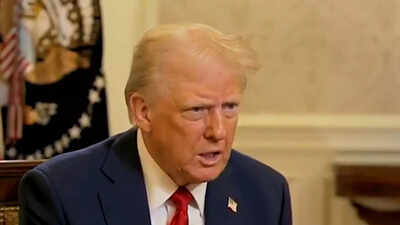
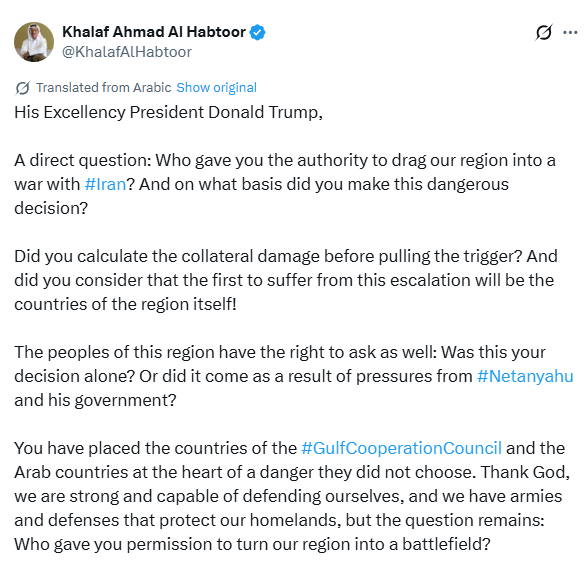
UAE billionaire Khalaf Al Habtoor on Thursday wrote an open letter to US President Donald Trump, questioning his authority to drag the Gulf and the Middle East into the ongoing military conflict with Iran.The founder of Al Habtoor Group raised questions in the open letter, authored in Arabic and shared on the social media platform X, asking Trump whether it was solely his decision to go to war or whether he was influenced by the Israeli Prime Minister Benjamin Netanyahu.
The US and Israel launched attacks against Iran on Saturday, targeting its leadership and military infrastructure. Following the US-Israel attack, Iran launched missile and drone attacks on the UAE and other Gulf countries.
The majority of those missiles and drones were intercepted and destroyed.The UAE and its neighbouring countries have been calling on all parties to end the conflict and engage in peace talks.“You have placed the Gulf Cooperation Council and the Arab countries at the heart of a danger they did not choose. Thank God, we are strong and capable of defending ourselves. We have armies and defences that protect our homelands.
But the question remains: Who gave you permission to turn our region into a battlefield?” said Al Habtoor.He said the US decision to go to war with Iran threatened the people of the region and the American people, whom he promised peace and prosperity.“And here they are today, finding themselves in a war funded from their money and taxes, with costs ranging, according to the Institute for Policy Studies (IPS), between 40-65 billion dollars for direct military operations, and could reach 210 billion dollars including economic impacts and indirect losses if it lasts four to five weeks, not to mention the sacrifice of Americans themselves in a war in which they have neither camel nor she-camel.
”Al Habtoor Group has been vocal in sharing its views on local, regional and global issues. He also funds a think tank to highlight and bring solutions to topical issues.Al Habtoor said the US President broke his promises of not getting involved in wars.“You ordered foreign military interventions during your second term in seven countries: Somalia, Iraq, Yemen, Nigeria, Syria, Iran, and Venezuela, in addition to naval operations in the Caribbean and the eastern Pacific Ocean.
You directed more than 658 foreign airstrikes in your first year in office, which equals the total strikes in (ex-US President Joe) Biden's entire term, for which you directed your arrows of criticism for involving the United States in foreign wars.
”He warned the US President that his approval ratings among Americans declined by about nine per cent in just 400 days as a result of these decisions.“These numbers say something clear: Even within the US, there is growing concern about being dragged into a new war, and about exposing the lives of Americans, their economy, and their future to unnecessary risks… If these initiatives were launched in the name of peace, then we have the right today to demand full transparency and clear accountability,” said Al Habtoor.In another message shared on X, Khalaf Al Habtoor questioned who would be held accountable for the damages inflicted on the Gulf and Middle East.“Who will pay the price for the tensions imposed on us as a result of a conflict we have no part in among Iran, America and Israel?” he said, adding that the entire region bears the consequences of the war involving three countries.“Our economies, our security, and the stability of our peoples are not arenas for settling scores among the great powers.
We are advocates of stability and peace, and we did not choose to be part of this confrontation. Yet we find ourselves paying the price for an escalation we did not create,” he added.“The question that must be asked clearly today is: Who is responsible and who will compensate for the losses incurred by the region’s countries and peoples due to the conflicts of others? The region needs a cool head, not more reactions that fan the flames higher,” he concluded.