7 months ago
27
7 months ago
27

Richard WheelerPolitical reporter

 Shutterstock
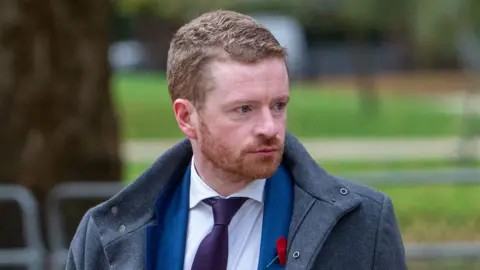
Morgan McSweeney has long been considered instrumental to the rise of Sir Keir Starmer - it remains to be seen whether his resignation as chief of staff helps keeps his former boss in position.
The prime minister's right-hand man leaves government after several Labour MPs and peers called for someone to be held accountable for the decision to appoint Peter Mandelson as UK ambassador to the United States.
While Lord Mandelson was sacked from the role last September, pressure mounted on Downing Street when newly-released files raised further questions about the peer's relationship with convicted sex offender Jeffrey Epstein.
Questions focused on how much the prime minister knew at the time of Lord Mandelson's appointment as well as the vetting process.
Sir Keir apologised last week, using a press conference to state that "none of us knew the depths and the darkness" of the relationship between Lord Mandelson and Epstein.
On Sunday, McSweeney claimed "full responsibility" for advising the prime minister to make that appointment.
Announcing his resignation as chief of staff, he said: "The decision to appoint Peter Mandelson was wrong."
McSweeney derived his power and influence from his track record as a political strategist - he masterminded Labour's landslide 2024 general election victory and Sir Keir's 2020 Labour leadership bid.
Like previous powerful but unelected advisers in Downing Street, such as Dominic Cummings or Alastair Campbell, he has been the target of negative stories.
His closeness to Sir Keir - as a seasoned political operator to a relatively inexperienced prime minister - meant he was seen as "proxy" for the PM.
McSweeney emerged victorious from an internal power struggle to become Sir Keir's chief of staff in 2024 after the dramatic resignation of Sue Gray.
Quiet, unassuming, even shy, particularly in public, McSweeney was known for being obsessed by winning, constantly fearful of complacency and ever aware of Labour's track record of losing far more elections than it wins.
Born in Macroom, County Cork, he had a comfortable upbringing as the son of an accountant and a retired office worker, according to a profile by The Times newspaper's Patrick Maguire and Gabriel Pogrund.
He moved to London as a teenager, initially working on building sites before winning a place at the London School of Economics.
According to the book Get In, authored by Maguire and Pogrund, he dropped out and went to live in an Israeli kibbutz for six months, before returning to London to study at Middlesex University - leaving with a degree in politics and marketing.
McSweeney then joined Labour under Tony Blair, working in a junior role at the party's headquarters.
He later started working for Steve Reed, who is now housing secretary, but at the time was a councillor in Lambeth, south London, where he was trying to regain control of the party from the hard left.
In 2006, McSweeney helped run the party's successful campaign to take control of the council, with Reed becoming leader.
His reputation as a skilled campaign strategist was further cemented in Barking and Dagenham, where the far-right, anti-immigrant British National Party was gaining support and hoping to win its first parliamentary seat 2010.
McSweeney played a key role in the fight to defeat the BNP in the area, with a campaign which focused on local issues.
However, his campaigns were not always a success - in 2015 he ran Blairite Liz Kendall's bid to become Labour leader, where she secured only 4.5% of votes in the contest won by Jeremy Corbyn.
In 2017, McSweeney became a director of the think tank Labour Together, which opposed the direction of the party under Corbyn and went on to back Sir Keir.
The Electoral Commission later fined Labour Together £14,250 for late and inaccurate reporting of donations during the period when McSweeney was a director.
The fine later fuelled calls from Conservative MPs for a deeper investigation into Labour's campaign finances - though the Electoral Commission decided not to reopen an investigation.
At the time of the fine, McSweeney had left Labour Together to run Sir Keir's 2020 leadership bid, later becoming his chief of staff in opposition, where he played a key role in removing Corbyn supporters from positions of power.
The Times reported it was here that he masterminded what became Starmer's three-year plan: detoxifying the party, becoming an effective opposition then outflanking the Conservatives on crime, defence and the economy in order to win power.
As Labour's campaign director, McSweeney was tasked with devising the party's strategy for the 2024 general election, including Labour's selection process for parliamentary candidates, which saw left-wing figures sidelined and caused fierce rows with the trade union movement.
Among the new Labour MPs to be elected was his wife, Imogen Walker, a former councillor in Lambeth who now represents Hamilton and Clyde Valley.
McSweeney was credited with keeping Labour HQ focussed on winning back so called "hero voters", the Leave-backing constituents who supported Boris Johnson in 2019 but were willing to swing back behind Labour.
He also oversaw the deployment of money and teams into marginal constituencies, often to the detriment of senior Labour figures in safe seats.
The result was a historic landslide, with Labour gaining over 200 seats despite increasing their vote share by less than two percentage points.