1 month ago
28
1 month ago
28

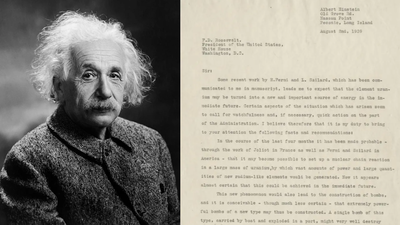
Image: Left/Wikipedia/Right/Bulletin of Atomic Scientists
Few names are as closely linked with the atomic bomb as Albert Einstein's. Mention nuclear weapons and, sooner or later, someone will bring up his famous equation, E = mc². Over the decades, that association has fuelled one of history's most persistent misconceptions: that Einstein helped build the bomb itself.The reality is far more nuanced and, in many ways, more compelling. Einstein never worked on the Manhattan Project, never stepped inside its secret laboratories and never contributed to the engineering that produced the first nuclear weapon. Instead, his involvement was limited to a single decision that would weigh heavily on him for the rest of his life: signing a letter warning the United States that Nazi Germany might be racing to develop an atomic bomb.Ironically, the scientist so often portrayed as the father of the bomb spent much of his later life arguing against the very kind of weapons his name had become associated with. His story is less about invention than conscience, a reminder that scientific discovery and political decision-making rarely travel the same path.
Why did Albert Einstein never work on the atomic bomb project
According to the Atomic Heritage Foundation, contrary to popular belief, Albert Einstein played no direct role in the Manhattan Project, the top-secret American programme that developed the world's first nuclear weapons during the Second World War.
National World War II Museum described the project as ‘the destroyer of worlds,’Part of the reason was practical. Einstein was a theoretical physicist whose work transformed our understanding of space, time and energy. Designing a functioning atomic bomb demanded a different kind of expertise, experimental physics, engineering, metallurgy and large-scale industrial coordination. Politics also stood in his way.Despite fleeing Nazi Germany and becoming an American citizen, Einstein never received the security clearance required to work on classified wartime projects.
According to National Geographic, the Federal Bureau of Investigation (FBI) viewed him with suspicion because of his outspoken political views, his support for civil rights and pacifist causes, and his connections with a wide range of humanitarian and intellectual organisations.
Those concerns resulted in an extensive FBI file running well over a thousand pages.Peter Klarnet, senior specialist for Americana, books and manuscripts at Christie's, told the BBC, did not have the security clearance for that because his left-leaning political beliefs were overt.
In fact, the avowed pacifist distanced himself from the project and always insisted that his part in the release of atomic energy was "quite indirect".It is one of history's quieter ironies. The man whose name became synonymous with the atomic age was never allowed anywhere near America's most secret nuclear programme.
The letter that changed history and haunted Einstein afterwards
If Einstein never built the bomb, why is he so closely connected to it? The answer lies in a letter written during one of the darkest moments of the twentieth century.In August 1939, physicist Leo Szilard, posted by the Bulletin of Atomic Scientists, deeply alarmed by advances in nuclear fission and the possibility that Adolf Hitler's Germany could weaponise uranium, approached Einstein for help. Einstein's international reputation ensured that any warning bearing his signature would carry enormous weight.The resulting letter, addressed to US President Franklin D. Roosevelt, urged the American government to take the threat seriously and invest in uranium research before Germany did.
Historians generally regard it as one of the events that encouraged the United States to begin the research efforts that later evolved into the Manhattan Project.Einstein's decision was driven by fear rather than enthusiasm. He believed that if the Nazis acquired an atomic bomb first, the consequences could be catastrophic.Once the war ended and it became clear that Germany had never come close to producing such a weapon, his perspective shifted dramatically. Looking back at a 1947 interview, he admitted:"Had I known that the Germans would not succeed in developing an atomic bomb, I would have done nothing."Those words reveal a man wrestling with hindsight rather than trying to rewrite history. Faced with the information available in 1939, he made a choice he believed might prevent an even greater catastrophe. It was a burden he never entirely shook off.
How Albert Einstein became one of the world's strongest opponents of nuclear weapons
The bombings of Hiroshima and Nagasaki profoundly affected Einstein, despite his lack of involvement in the Manhattan Project. From that point onwards, he increasingly devoted his public voice to warning about the dangers of nuclear warfare.In 1946, he helped establish the Emergency Committee of Atomic Scientists, an organisation dedicated to educating the public about the unprecedented risks posed by atomic weapons. Einstein argued that humanity's scientific achievements had outpaced its political wisdom, a theme that would define his later years.He wrote:"The unleashed power of the atom has changed everything save our modes of thinking, and thus we drift toward unparalleled catastrophe."It remains one of the clearest summaries of the nuclear dilemma. Science had transformed the world in a matter of years; human institutions, Einstein believed, had barely begun to catch up.His final public statement reinforced that message. Shortly before he died in 1955, Einstein joined philosopher Bertrand Russell in endorsing what became known as the Russell–Einstein Manifesto, an appeal urging world leaders to resolve conflicts through diplomacy rather than war.Its closing words have echoed through decades of disarmament campaigns:"Remember your humanity, and forget the rest."The manifesto later inspired the Pugwash Conferences on Science and World Affairs, whose efforts to reduce the threat of nuclear conflict earned the 1995 Nobel Peace Prize.
A legacy shaped by responsibility, not weaponry
Albert Einstein did not refuse to build the atomic bomb because he turned down an invitation. In truth, no such invitation ever came. Excluded from the Manhattan Project and denied security clearance, his direct involvement in the atomic age amounted to a single, fateful signature on a letter born out of wartime fear.That distinction matters because it reshapes how we remember him. Einstein's legacy is not one of designing weapons but of confronting the moral consequences of scientific progress. Few figures illustrate more clearly how knowledge can change the world, while wisdom determines what humanity chooses to do with it.