5 months ago
20
5 months ago
20

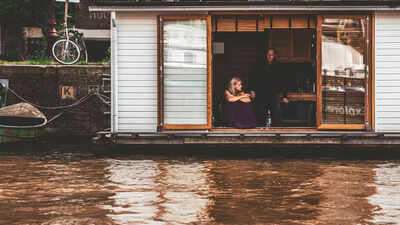
Netherlands is building homes on water (Image source: Canva)
The Netherlands has always lived with water. A large part of the country is lower than sea level. Rivers, canals, and coastlines affect how people live every day. The Dutch have been building dikes, dams, and drainage systems to protect their land for hundreds of years.
But in the last few years, this problem has gotten worse because sea levels are rising, it rains more, and flooding happens more often. At the same time, there aren't enough homes in the country.There are millions of people looking for cheap homes, but there isn't much land left. Instead of fighting water, many Dutch communities are learning to live on it. Floating homes, once seen as unusual, are now becoming part of modern urban planning.
According to the BBC reports, these water-based neighbourhoods are growing in number and influence. What began as small experiments is now shaping international projects in vulnerable coastal regions.
The Dutch model of floating housing could be a way to deal with both climate change and a lack of housing at the same time, from Europe to island nations.This is the story of how floating homes moved from niche projects to a global example of climate adaptation.
Why floating homes in the Netherlands are gaining attention
The Netherlands is one of the most flood-prone countries in the world. Storm surges, heavy rainfall, and rising sea levels all increase the risk of damage. Climate scientists warn that these threats will grow in the coming decades.At the same time, the country needs new housing. Officials estimate that about one million new homes will be required over the next ten years. However, suitable land is scarce. Many areas are already densely built or protected for agriculture and nature.Floating homes offer a way to use water space instead of land. Canals, lakes, and harbours can become places for housing without taking away farmland or green zones.For many years, water was seen mainly as a danger. The goal was to keep it out at all costs. Today, city planners are adopting a different approach. They are trying to work with water rather than against it.This change in mindset is central to the growth of floating communities.
Instead of building higher walls and stronger barriers, some cities are creating homes that rise and fall with changing water levels.
How Dutch floating homes are built: Not houseboats, but real homes
Floating homes in the Netherlands are not traditional houseboats. They are permanent buildings made with modern construction materials. Most are built on concrete platforms that act as floating foundations.These platforms are attached to steel poles driven into the waterbed.
The poles allow the houses to move up and down but keep them in place. This system helps the homes stay stable during storms and changing water levels.The buildings are also connected to electricity, water, sewage, and internet networks. From the inside, they look much like regular houses on land.The concrete hull beneath each home works as a counterweight. This keeps the structure balanced. Even in rough weather, movement is usually limited.Siti Boelen, a resident of one floating community, told the BBC that she feels safer during storms because her home floats instead of resisting water pressure. This feeling of security is one reason why more people are interested in water-based housing.
Schoonschip: A floating community in Amsterdam
One of the best-known floating neighbourhoods is Schoonschip in Amsterdam. The project began in 2009, initiated by Dutch television director Marjan de Blok. Her idea was to create a sustainable community on water.
After years of planning and cooperation with authorities, Schoonschip became a reality. Today, it consists of 30 floating homes, including duplex houses. They are located in a former industrial canal area.Residents of Schoonschip share many systems. They operate joint heat pumps for heating and cooling. Solar panels cover about one-third of each roof. Energy is shared within the community.Rainwater collection, waste management, and electric transport are also part of daily life.
These features reduce environmental impact and lower costs.As reported by the BBC, Schoonschip shows how floating housing can combine climate adaptation with sustainable living.
Support from local governments
Amsterdam city officials are now adjusting planning laws to support more floating projects. Nienke van Renssen, a city councillor from the GreenLeft party, told the BBC that floating homes allow multifunctional use of space and fit long-term sustainability goals.By updating zoning regulations, the city hopes to make it easier for developers and residents to build on water.Rotterdam, another major Dutch city, has been working on climate adaptation for more than a decade. Much of the city lies below sea level.Since 2010, floating buildings have been part of its Climate Proof and Adaptation Strategy. Rotterdam hosts Europe’s largest floating office building and a floating dairy farm.Arnoud Molenaar, the city’s chief resilience officer, told the BBC that Rotterdam now sees water as an opportunity rather than only a threat.
How Dutch water housing is becoming a global climate solution
Dutch architects and engineers are now applying their knowledge overseas. Waterstudio, led by Koen Olthuis, has designed around 300 floating structures worldwide.One major project is underway in the Maldives. It aims to create a floating district that could house about 20,000 people.
The Maldives faces serious risks from rising sea levels, making floating housing especially relevant.Another company, Blue21, is developing plans for floating islands in the Baltic Sea designed for up to 50,000 residents.Olthuis told the BBC that floating homes are no longer seen as strange experiments. Instead, they are becoming part of what he calls “blue cities”, where water is used as a planning tool.This approach is now influencing coastal development in regions such as French Polynesia and Southeast Asia.
Challenges of living on water
Floating homes are not free from problems. Strong storms can still cause discomfort. Although the buildings are stable, movement can be felt during severe weather. Special infrastructure is also required. Utility connections, waste systems, and emergency access need careful design. Maintenance costs can be higher than for land-based housing.Building large floating neighbourhoods requires major investment.
Materials, technology, and engineering expertise are expensive.Rutger de Graaf of Blue21 told the BBC that large-scale development is essential because hundreds of millions of people may be displaced by rising seas later this century. However, reaching this scale will take time and political support.
Floating homes and the housing crisis
With one million new homes needed in the Netherlands, floating housing can play a supporting role. It cannot solve the shortage alone, but it adds valuable capacity.
By using water space, cities can expand without destroying green areas.For low-lying countries and island states, floating homes may become increasingly important. In places where land is disappearing, building on water may be one of the few available choices.The BBC reports show that Dutch-led projects are already influencing planning in vulnerable regions.
A model for climate-resilient living
Floating homes in the Netherlands represent more than a housing trend.
They reflect a deeper shift in how societies respond to environmental change.Instead of trying to control nature completely, these communities adapt to it. Homes rise with floods. Neighbourhoods are designed for flexibility. Energy and water systems are shared.From Amsterdam’s canals to projects in the Maldives, this model is spreading. It combines engineering, environmental awareness, and social cooperation.As climate risks grow and land becomes scarcer, living on water may become less of an exception and more of a necessity. The Dutch experience, documented by the BBC, shows how innovation, planning, and long-term thinking can turn a natural threat into a place to live.