9 hours ago
6
9 hours ago
6


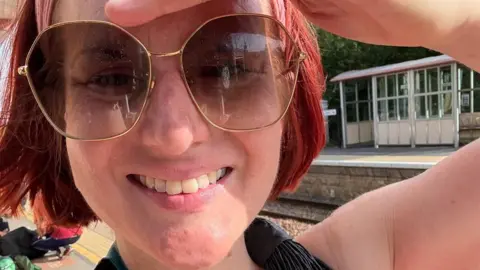 Gill Capewell
Gill Capewell says endometriosis was "ruining" her life
"I hate to say it, but if this condition was happening to men, things would be very different," says Gill Capewell.
The women who got in touch shared deeply personal insights into their condition, as well as medical records, photos, treatment information, and even in one case a dismissal letter.
Apart from endometriosis, they all have one thing in common: they want their stories to be heard so that endometriosis can be better understood and one day, maybe even cured.
"I have had fibroids and endometriosis for over five years, been passed from pillar to post around the NHS, been in debilitating pain and bleeding so much that I became severely anaemic," says Gill, from south-east London.
"At points, I couldn't leave the house because the blood flow was so intense and yet I could not get an appointment on the NHS to get anything done about it.
"It was ruining my life and yet not considered life-threatening."
Gill says that even though she wanted the chance to have children, she has now had a full hysterectomy.
"It is obviously devastating in some ways but a massive relief in others."
Freya Bowen says she has lived with intense menstrual pain since she was 14.
During her GCSEs she made repeated hospital visits but was told cysts and growths found during ultrasounds would pass on their own.
Just before her 18th birthday, she was admitted to hospital for three days with a serious infection, experiencing what she describes as "such severe pain I thought I was going to die".
"Yet I was repeatedly denied pain relief, to the point another patient across from me got up and looked for a nurse to treat me," says Freya.
A scan revealed she had appendiceal endometriosis and had probably been suffering from it for years.
She was told that her appendix would likely have burst if she had left the hospital.
Her appendix was removed and she was put on a waiting list for a specialist women's hospital.
"I am now 22 and have been waiting for over four years to leave that wait list, having had the referral lost and misplaced multiple times when it was almost the cause of my death," she explains.
Despite continuing pain, she says the only advice she has been given is to take the contraceptive pill.
"This is systemic misogyny playing out in our country's medical, professional and educational environments."
 Fahmida
Fahmida says there needs to be mandatory training for managers to understand how to support employees living with conditions like endometriosis
"Endometriosis is not 'just bad periods', it is a serious, life-altering disease that affects every part of a woman's life, from her health to her career and fertility," says Fahmida.
The 35-year-old from Newham had suffered from symptoms of endometriosis since she was 14 but was not formally diagnosed until 2017.
She says at her worst, she was "bedbound for months at a time" and at times she felt like someone was trying to "rip my organs out with barbed wire".
In 2019, an MRI scan revealed she had Stage 4 deep infiltrating endometriosis - the most severe form of the condition.
"While my medical journey has been incredibly challenging, what has been even harder has been my experience in the workplace," says Fahmida, who recently underwent surgery.
She said instead of receiving support for a "chronic and debilitating condition", she had "often been made to feel like a burden".
She says there needs to be mandatory training for managers so they understand how to support employees living with conditions like endometriosis.
"No woman should have to fight this disease while also fighting to be believed at work.
"All we are asking for is understanding, dignity and the chance to continue working with the support we need."
'Told I was too sensitive'
Fern Dixon says she had become so used to the pain of her agonising periods that she almost died from peritonitis and sepsis in early 2025.
"The reason I didn't seek any medical help until I was delirious with a fever is because the pain was nowhere near as bad as a regular period is for me," she explained in her email to me.
"I have been seeking help for my painful periods for 25 years. I was never believed, I was told I was too sensitive, or I was told I was just unlucky."
She waited four months before her appendix could be removed. Endometriosis was found in her peritoneal sac.
"I asked if it was found on the appendix, but the infection and scarring was so bad the doctor couldn't say for certain, but he suspected it was the underlying cause of the rupture," she says.
"I have since had one transvaginal ultrasound... I have not been offered any further treatment, despite the condition almost costing me my life."
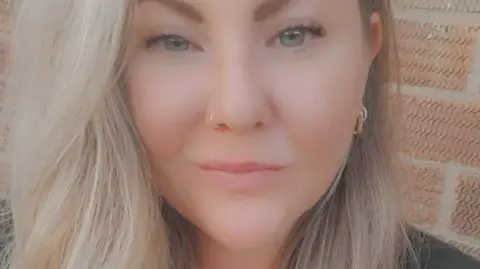 Kayleigh Glendon
Kayleigh says she was dismissed from her job due to "ill health"
Single parent Kayleigh Glendon, from Kent, had spent about 14 years trying to find out what was wrong before she was diagnosed with Stage 4 endometriosis in 2022.
"In 2023, I had surgery and found (endometriosis) was on my bladder, bowel, urethra, you name it, it was there," she recalls.
"In 2025, aged 38, I had hysterectomy surgery. The day before my surgery, a meeting was called with my managers and HR and even though I was a 'hard working, conscientious and valuable member of the team', I was dismissed, due to ill health."
She says she is waiting for a laparoscopic cholecystectomy to remove her gallbladder.
"My mental health has been at an all-time low, and losing a job I loved, due to my health issues, as you can imagine, has been soul destroying," she says.
Kayleigh's former employer has been contacted for comment.
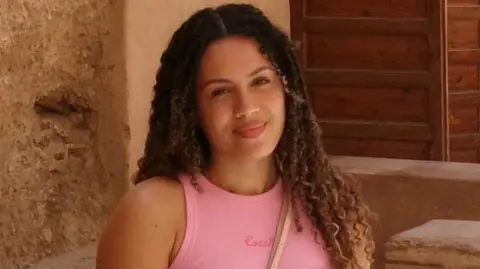 Image supplied
Rochelle, 27, has Stage 4 endometriosis
Rochelle, from Hertfordshire, is 27 years old and has suffered with painful periods from the age of 13.
She was put on the pill at 14, and although that helped with excessive bleeding, by aged 20 she was in excruciating pain each month.
Rochelle was offered the Mirena intrauterine device which worked for two years, after which the pain returned and was the worst it had ever been.
Fortunately Rochelle has private healthcare through work and a supportive manager, and an MRI scan in July 2025 confirmed she had severe Stage 4 endometriosis.
She has since undergone surgery.
"Aside from physical pain, the mental side is just as tormenting. I have never felt so low mentally, due to the constant pain and suffering," she says.
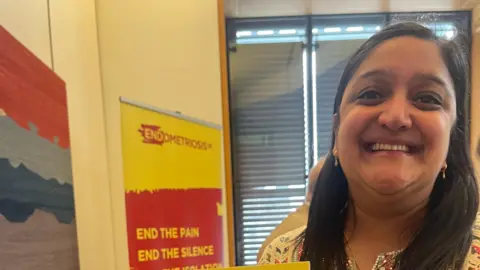
Sanju Pal says latest figures show it takes on average nine years and four months to get a diagnosis
For the woman whose story inspired others to come forward with their experiences, it has been a whirlwind start to 2026.
Sanju Pal has so far appeared on national and regional television and radio, and attended a number of events at Parliament during Endometriosis Awareness Month.
She is on a mission to have endometriosis officially recognised as a disability.
In the UK, a disability is defined under the Equality Act 2010 as a physical or mental impairment that has a substantial and long-term negative effect on a person's ability to carry out normal day-to-day activities.
Although endometriosis can be classed as a disability, it is not automatically recognised as such.
As she arrived at Portcullis House in Westminster for the launch of the latest figures from Endometriosis UK, Sanju said she was more determined than ever to make a change.
“The report says that it takes on average nine years and four months to get a diagnosis," she says.
"That's why my campaign goes wider than endometriosis, it's for all gynaecological conditions that are fluctuating and recurring to be part of the definition of disability, so that women in the UK get their fair rights in the workplace.
"That is something that needs changing and I'm here to do it."
- If you have been affected by any of the issues raised in this story, information and support can be found at the BBC's Action Line.