1 hour ago
4
1 hour ago
4

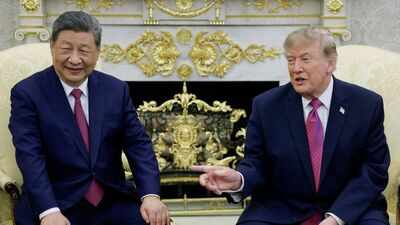
Trump and Xi continued to discuss future US arms sales to Taiwan.
US President Donald Trump sought to downplay Washington's pending arms sale to Taiwan by telling Chinese President Xi Jinping that the US sells weapons to countries around the world, and even asking whether China would like to buy some, according to US ambassador to China David Perdue.“President Trump continues to say, hey, we sell arms to other people around the world. He actually asked President Xi, would he like to buy some at one point,” Perdue told Fox News on Sunday.Perdue made the remarks days after Trump hosted Xi for a state visit in Washington. He did not specify when Trump made the comment or provide further details about the exchange.Perdue was speaking about US policy toward Taiwan, which has been waiting for months for Trump to approve a new arms package worth about $14 billion.Fox News host Shannon Bream had raised concerns from Republican and Democratic lawmakers about delays in US weapons orders and aid packages for Taiwan, which is seeking to strengthen its defences against a potential Chinese attack.Bream asked whether Washington was holding back arms sales to Taiwan to avoid angering Xi. Perdue rejected that suggestion, saying Trump “is as strong on Taiwan as I've ever seen anybody” and has already approved substantial weapons sales to the island.
Earlier, Trump also sought to play down Taiwan as a major point of friction with Beijing, saying the issue did not feature prominently in his latest talks with Xi.“We didn't talk about Taiwan too much with Xi. Right now, it's, you know, fine. It's just moving along. Xi understands very much how I feel,” Trump told reporters.Trump and Xi met at the White House last week as Washington and Beijing sought to stabilise ties following months of tensions over trade, technology and other geopolitical issues.The summit resulted in an extension of the US-China trade truce, while differences over Taiwan, artificial intelligence and Iran remained.Taiwan arms package remains pendingTaiwan has been waiting for months for Washington to approve a proposed arms package worth about $14 billion, following an $11 billion weapons deal announced last December.The latest package was put on hold after Trump’s meeting with Xi in Beijing in May.
Trump has not indicated whether the deal will move forward following their latest summit.He had previously described arms sales to Taiwan as a “very good negotiating chip” in dealings with China.Beijing has repeatedly urged Washington to halt arms sales to Taiwan, which China claims as part of its territory. Ahead of the latest summit, China had made clear that Taiwan remained a major issue in its talks with Washington.According to China’s official news agency Xinhua, Xi urged Trump to “prudently handle the Taiwan question” and called on Washington to oppose Taiwan independence. The White House did not immediately release its own account of the discussion on Taiwan.Earlier, Taiwan deputy foreign minister Chen Ming-chi said Washington “very much” understands the island’s defence requirements and the military pressure it faces from China.“Taiwan faces a severe situation in the Taiwan Strait. Even though China's economy is declining, it continues investing more resources into building military capacity. Under this context, the US very much understands our defence needs,” Chen said.“We do continuously communicate with them, and we believe the US understands the situation we face and our determination on defence investment completely,” he added.Chen also said Taiwan had repeatedly received assurances from Washington that its policy toward the island had not changed. Perdue separately told CNBC that there had been no change in Trump’s Taiwan policy, including on arms sales.US balancing ties with China & TaiwanUnder US law, Washington is required to provide Taiwan with the means to defend itself. The US does not formally recognise Taiwan as an independent country but remains its main informal security partner and arms supplier.At the same time, successive US administrations have left unclear whether Washington would directly intervene militarily if China attacked Taiwan.Beijing considers Taiwan part of China and opposes US arms sales to the island. Taiwan rejects China’s sovereignty claims and maintains that its future can be decided only by its people.