
 5 months ago
46
5 months ago
46

Sean McManusTechnology Reporter

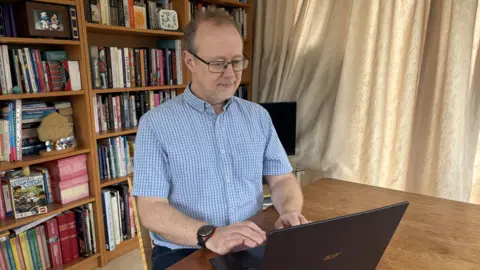 Sean McManus
Sean created three apps using the Kineto service
Recently I decided to have a go at building some apps.
Not long ago, that would have been a job for specialists. But start-ups have emerged offering app production for the novice, with the help of AI.
I used a service from Kineto a start-up that has been spun out of JetBrains, a company that makes popular software developer tools.
The builder tool and the apps you create run in the browser, so you don't need to download or install anything. When you publish an app, you can distribute it by sharing the link.
I put Kineto to the test by building three apps.
My wife requested a flashcard tool so she could drill her French vocabulary, with the ability to add and edit multiple word lists.
My son needed a typing tutor using meaningful sentences that would score his accuracy and speed. And I wanted a tool to find broken links on my website.
For each one, I entered a description, chose a colour scheme and waited for version one of the app to be built.
However software is developed, it's rare for it to work perfectly first time.
Kineto requires the same sequence of building, testing and refining the app that manual coding does. The first two versions of the typing tutor, for example, didn't recognise any keypresses. When you spot an error or an opportunity to improve the app, you describe it and Kineto builds you a new app version.
Kineto's apps run in the browser, which requires a web connection, and aren't available in app stores. To avoid security and privacy risks, no code runs on your device and data access is limited to explicit uploads.
 Andrew Zakonov
Andrew Zakonov hopes customers will be able to create an app in half an hour
Andrew Zakonov, founder of Kineto, says it can take an hour or two, and 10 iterations, to get a good result today.
"I'm sure that soon enough we'll get to the point where it's half an hour [to make an app] for your kids," says Zakonov.
"But that requires a few more technology breakthroughs. I'd expect them to be quite soon."
The apps I made looked polished, worked well and were intuitive to use. The typing tutor and vocab trainer were easy to make based on a description of the app and a few rounds of refinements.
The most sophisticated program, the link checker, was harder to build. It required much more bug fixing and tweaking, including help from the support team using specialised knowledge in their prompts.
In the background, a number of AI agents work together to build your apps, each one dedicated to a task such as image creation, web searches or app testing. The Kineto team measures the performance of large language models to work out which is best suited to each task.
"We try to remove the most basic problems before delivering the first version [of your app] to you. At the same time, we're always balancing that with the time you wait," says Zakonov.
Kineto has higher price tiers allowing more published projects, more storage for apps, and additional AI credits. For these, it is targeting online content creators, for example, YouTubers, who could make apps such as interactive courses.
"I believe that interactive apps are the next mainstream medium," says Zakonov.
What is an app developer's view of such technology?
Jules Goldberg is the founder of Reviva Softworks. He taught himself to code and developed the mobile app SnoreLab.
It records your snoring using the microphone and tracks it, so you can test remedies to see if they help. The app has had 15 million downloads, and Goldberg now has a team of eight mobile app developers working with him on SnoreLab and other apps.
He sees the upside of services like Kineto. "There's something very wonderful about making [app creation] accessible for people to express their creativity," he says. "It's a thrilling process."
But in his opinion, AI app creation will never be mainstream.
"Humans are a bit lazy. It will always be less effort to download someone else's work."
He also doubts whether there will be a business in selling AI-generated apps.
"When it is so easy to create simple apps, like a habit tracker or a quiz, it devalues them," Goldberg says. "Why should anyone buy one if you can just make it in a click?"
Will such DIY tech threaten his own business? Goldberg does not think so, arguing his firm's experience, research and technology make it defensible.
"There's a danger that [AI tools] might be focused on the presentation, which looks amazing, but there's no depth," he says. "It's the depth that makes something good."
"Even if it becomes easier to build a superficial app, it's enormously expensive to get that app in front of people. Established apps still have a huge market advantage."
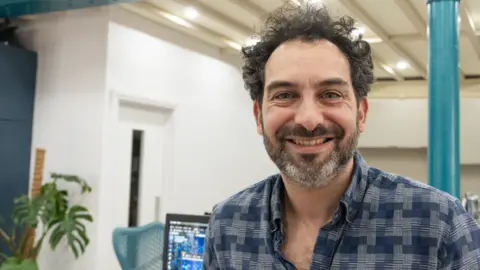 Reviva Softworks
Jules Goldberg developed an app to track snoring
Nevertheless, Zakonov is optimistic about the prospects for DIY app building.
"Kineto started out of curiosity," he says. "It was obvious that we could create a lot of useful [AI-based] tooling for developers, for professionals. But we thought: what would happen if we tried to make a really smooth experience with no requirement to learn stuff?
"Pretty much everyone could be a creator someday if we remove the barriers and if we make this process easy, fun and interactive."
More Technology of Business


