5 months ago
40
5 months ago
40


 Matt Dempsey
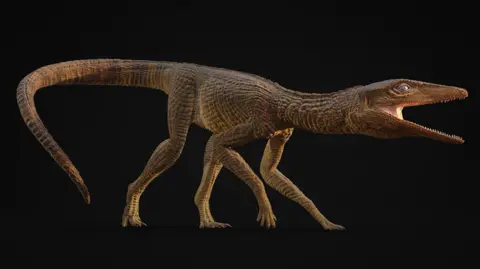
Life reconstruction of Galahadosuchus jonesi in an orthographic projection
A newly-identified species of ancient crocodile has been named after an "inspirational" teacher by the scientist leading the research.
Ewan Bodenham, 29, named the prehistoric reptile after his former physics teacher David Rhys Jones in Cardigan, Ceredigion.
The species of crocodylomorph roamed Earth about 215 million years ago during the Triassic period and is believed to have been a fast-moving, land-dwelling predator resembling a "reptilian greyhound".
It has officially been given the Latin name Galahadosuchus jonesi - with the first part referencing Galahad, the Arthurian knight famed for his moral uprightness, a nod to the animal's upright stance, while the second honours Jones.
 Ewan Bodenham
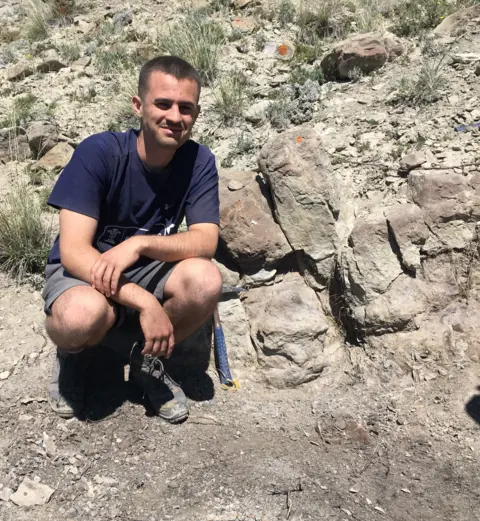
Ewan Bodenham is a PhD student at the Natural History Museum London and UCL
Bodenham, now a PhD student studying at UCL and the Natural History Museum in London, had originally hoped to surprise Jones with the honour during a school assembly at Ysgol Uwchradd Aberteifi.
However, the scientific paper detailing the discovery was published sooner than expected, meaning he had to break the news to him during a video call instead.
"The first chapter of my thesis is naming a new species of fossil crocodile, and I'm naming it after you," Bodenham told him.
"Good God, what an honour. What a privilege," Jones responds.
"That's very, very kind of you to remember me."
"Honestly, you were such an inspiration in school," Bodenham says, "I'm welling up a bit."
"Hang on - I still am, I'm still here!" Jones jokes.
 Bodenham et al., 2026
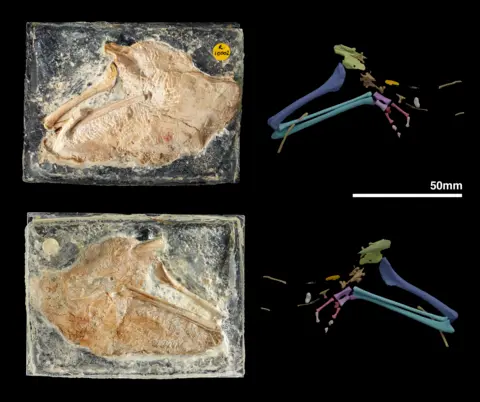
Bodenham studied fossils that had originally been discovered in Gloucestershire in 1969
The fossil studied by Bodenham was originally discovered in Gloucestershire in 1969 but had remained in the Natural History Museum collection for decades before being examined in detail.
The geological deposits where it was found occur across south Wales and south-west England.
His former teacher's influence played a major role in shaping his academic path, even though he ultimately chose to pursue biology rather than physics, which Jones jokingly refers to as a "softer science".
"Mr Jones was just such a good teacher, not only in being able to explain things well, but you could tell that he was genuinely interested in the sciences. I think that really inspired me," said Bodenham.
"He also didn't let me settle. He was very good at challenging people and helping students be the best they can be. Above all, he's a very funny, genuine, nice guy.
"He was also a big part in getting me to go to London, as he went to UCL as well and really helped to push me to go there."
Bodenham said the decision to name the species after Jones had been warmly received by both his former teacher and the wider community.
He noted that other potential candidates for the honour, such as family members and his girlfriend, had not been upset by the decision.
"It's been a very positive response and I think he [Jones] has also received a lot of nice messages and is a very well-liked person within the school and community," he said.
How was this new species identified?
Bodenham added that his interest in studying crocodylomorphs came about somewhat unexpectedly.
"I was on a PhD programme and my current supervisor had this as an outline of a project and so I took it from there.
"It's not like I've been obsessed with crocs from a young age or whatever, they're just a good group for studying the types of questions I like to work on."
Researchers initially compared the specimen to the Terrestrisuchus, another early member of the crocodylomorpha group - also known for its long legs and fully terrestrial lifestyle.
"My PhD project is looking at the evolutionary relationships of these early crocodiles," said Bodenham.
"So we conducted a detailed anatomical description of this specimen, making comparisons to other early crocodiles to determine if it was another specimen of Terrestrisuchus or if it was something new."
The team found 13 key differences between the fossils, significant enough to name the specimen an entirely new species.
Bodenham's discovery adds another piece to the growing diversity of animals living in this region during the Late Triassic before the Triassic–Jurassic mass extinction event caused by an increase in volcanic activity altering the climate.