7 months ago
50
7 months ago
50

Tessa WongAsia Digital Reporter

 AFP via Getty Images
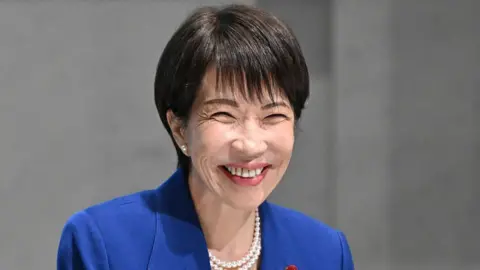
Analysts say Takaichi's huge win at the recent election has given her political capital to stand firm against China
Last month at Tokyo's Ueno Zoo, after receiving thousands of tearful goodbyes from Japanese fans, Xiao Xiao and Lei Lei were put on a plane bound for China - the latest symbols of the deteriorating relationship between China and Japan.
Since Japan's Prime Minister Sanae Takaichi made comments that have plunged ties with China to their lowest level in years, Beijing has been piling on the pressure in a wide range of ways - sending warships, throttling rare earth exports, curbing Chinese tourism, cancelling concerts and even reclaiming its pandas.
The row began in November, when Takaichi appeared to suggest that Japan would activate its self-defence force in the event of an attack on Taiwan.
China claims self-governed Taiwan as its own and has not ruled out the use of force to "reunify" with it one day. The island counts the US as its key ally, and Washington has pledged to help Taiwan defend itself.
The worry has long been that any attack on Taiwan could result in a direct military conflict between the US and China, and then widen to include other US allies in the region such as Japan and the Philippines.
The issue of Taiwan is an absolute red line for China, which reacts furiously to any comment perceived as "outside interference" and insists that it is a question of sovereignty that only China can decide for itself.
Almost immediately after Takaichi's remarks, Beijing responded with a flurry of condemnation and demanded a retraction.
Observers have noted that Takaichi's comments were in line with the government's position and what other Japanese leaders have said in the past.
But the difference is that it was the first time a sitting Japanese prime minister had voiced such views.
For her part, Takaichi refused to apologise or retract her remarks, a stance that analysts say may likely be vindicated by the strong mandate she has won.
But she said she would be more careful about commenting on specific scenarios, and her government has sent senior diplomats to meet their Chinese counterparts.
This, however, has done little to allay Chinese anger.
Faced with Takaichi's steady refusal to back down, China has piled on a steady stream of pressure.
While spats have flared up between the two countries in recent decades, fueled by historical animosity, this time it feels different, say analysts.
China has expanded its pressure on a much "wider range of fronts", noted Robert Ward, the Japan chair for the think tank International Institute of Strategic Studies.
It is a diffuse, low-level pressure that is similar to the "greyzone warfare" it conducts on Taiwan, he said, where it's aimed at "wearing down [the opponent] to normalise things that actually are not normal".
Diplomatically, it has lodged complaints with the United Nations and postponed a trilateral summit with Japan and South Korea.
China has also tried to pull other parties into the fray and has called on the UK and France to side with it, while urging its allies Russia and North Korea to denounce Japan.
Over the weekend, Chinese foreign minister Wang Yi invoked Japan's World War Two history of aggression while addressing Western leaders at the Munich Security Conference, and called Takaichi's remarks a "very dangerous development".
On the military front, Japan has claimed that China has sent drones, sailed warships past their islands and its fighter jets have "locked radars" on their planes. Japanese and Chinese coast guard ships have confronted one another near the disputed Senkaku/Diaoyu islands, while last week Japanese authorities seized a Chinese fishing vessel.
But it is clear that China also wants to hit Japan where it hurts - its economy.
Beijing has imposed restrictions on exports to Japan for dual-use technologies including rare earth elements and critical minerals, in what has been seen as a form of economic coercion.
It has also warned Chinese citizens to avoid Japan for their studies and holidays, and cancelled flight on 49 routes to Japan, leading to a drop in tourists and a slide in some stocks. Chinese nationals make up a quarter of all foreign tourists to Japan, according to official figures.
Even entertainment and culture is not off the hook.
One of Japan's most famous cultural exports, Pokemon, was also criticised over an event that was due to be held at the Yasukuni Shrine. The temple honours Japan's war dead including some that China considers as war criminals. The event was eventually cancelled.
And on the social media front, Chinese online nationalists have launched attacks on Takaichi, including sharing AI-generated videos showing pop culture figure Ultraman and anime character Detective Conan fighting the prime minister.
 Getty Images
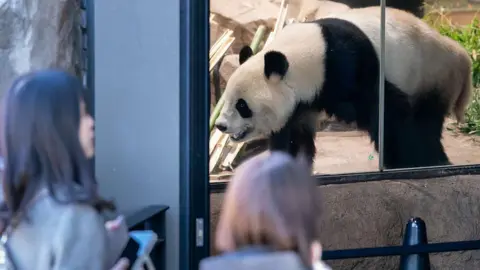
Xiao Xiao, seen here on his final day in Ueno Zoo, was sent back to China along with his sister Lei Lei
But overall, China has taken actions that have been less provocative compared to previous conflicts with Japan, noted Bonny Lin and Kristi Govella with the think tank Center for Strategic and International Studies (CSIS).
"Thus far, its economic and military responses have been relatively limited compared to the past, but there is ample room for further escalation," they noted in a recent analysis.
China may also be holding back on going too hard on Japan as it is currently "actively positioning itself as the guardian of the post World War Two order" and wants to be seen as a responsible power compared to the US, added Ward.
A 'tango that will continue'
Observers agree that if or when tensions calm down, they will likely settle at a higher level than before.
Both sides are less likely to de-escalate this time round, noted Lin and Govella in their analysis. China is a much stronger power now, and "Taiwan is the core of Chinese core interests, which means that Beijing is more likely to take a hardline position than in past episodes".
"Beijing is also deeply suspicious of Takaichi and are likely to view her attempts to de-escalate without explicitly retracting her comments as hypocritical or, even worse, strategically deceptive," they added.
Meanwhile, Japan has a greater appetite to stand firm especially with Takaichi's huge electoral win, which "she will take this as vindication for her stance on China", noted Ward.
Govella told the BBC that Takaichi would likely use her win as "political capital" to advance defence and economic policies that will strengthen Japan's position.
Takaichi has pledged to raise Japan's defence-related spending to 2% of the GDP two years ahead of schedule, complete a revision of key security strategies by the end of this year, and launch an economic stimulus package soon.
In turn, China "sees that Takaichi is a pretty strong leader and the pressure campaign could only make her stronger domestically, [so] they may not intensify their pressure much," said Kiyoteru Tsutsui, a Japan expert and director of the Shorenstein Asia-Pacific Research Center at Stanford University.
"So this tango will likely continue on for a while."
The wildcard could be that US President Donald Trump has so far pledged strong support for Takaichi, issuing an unusual endorsement for her in the run-up to the snap election.
But many expect US-China relations to warm further this year, Tsutsui noted, with several scheduled meetings between Trump and Chinese President Xi Jinping including the US president's state visit to Beijing in April.
And compared to previous incidents, the US response to the latest spat "has been muted so far, which may embolden China", said Lin and Govella.
"The Japanese are terrified there's going to be some grand bargain between Xi and Trump," said Ward.
Over the weekend, the US and Japan affirmed their ties on the sidelines of the Munich Security Conference in a meeting between US Secretary of State Marco Rubio and his Japanese counterpart Toshimitsu Motegi.
Takaichi is also due to meet Trump again in March when she visits Washington DC, ahead of his trip to China.
As China keeps piling on the pressure, Tokyo will likely "double down" on shouldering more of the defence burden it shares with the US, said Ward, and "really work more closely with them to make sure that the US doesn't sort of drift off and lose interest in the region".