1 hour ago
4
1 hour ago
4

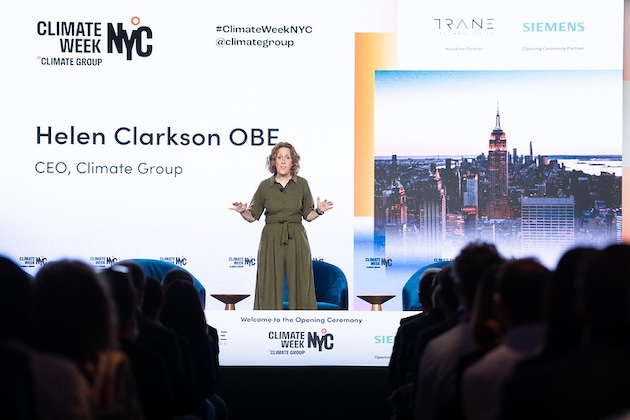 Helen Clarkson, CEO, Climate Group at Climate Week NYC. Credit: Climate Group
NEW YORK, September 22 (IPS) - The Climate Group’s annual conference in New York City has attracted thousands of attendees this year, among them world leaders, corporate heads, philanthropists, and climate advocates. Those leaders present at the opening ceremony of Climate Week have made clear calls to collectively tackle climate issues.
Climate Week NYC’s opening ceremony and conference began on Monday in conjunction with the United Nations General Assembly Debate and High-Level Week (21-29 September). In addition to the main conference, held in the Glass House on 12th Avenue, there are multiple events hosted across New York City—more than 1,500. This is slated to be the biggest Climate Week yet, according to the Climate Group, the organizers of this week-long event.
Each year, Climate Week focuses on the most urgent issues when it comes to tackling climate change, from the transition to renewable energy, corporate and government responsibility, and scaling climate and economic progress.
The consequences of climate change, including extreme weather events, rising temperatures, and sea levels, are being felt worldwide. Global conflicts like the war between Russia and Ukraine and the situation in the Middle East have disrupted the world’s energy supply of oil and gas, which has put developed and developing countries alike in prolonged stress over energy needs.
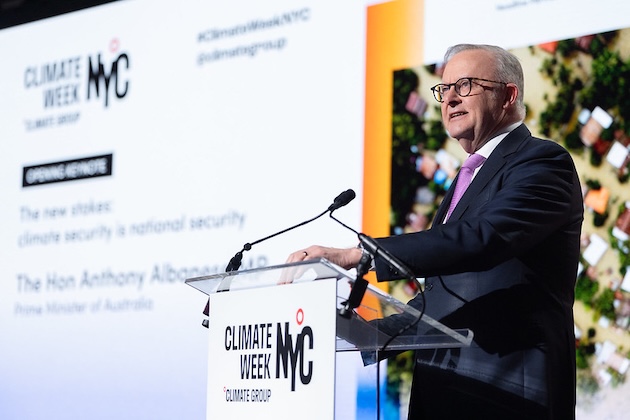 Australian PM M Anthony Albanese. Credit: Climate Group
It is the latter point that the day’s first speakers urged on, as even in the face of mounting evidence that clean energy is more affordable, countries still rely on fossil fuels. But blaming the situation solely on fossil fuel companies would not be accurate. Helen Clarkson, the founder of Climate Group, pointed out in her opening remarks that incumbents still use and rely on fossil fuels for their energy needs. She also pointed her finger at right-wing pundits in traditional and social media that spread misinformation about renewable energy and politicians who “weaponize people’s fear.” Meanwhile, some leaders and even media outlets choose not to use the word ‘climate’ in relation to these issues in a form of erasure or denial. Silence is a form of inaction, Clarkson noted soberly, and that inaction leads to more climate change.
“It’s time to face the truth, and that’s hard in a world where truth has lost so much of its currency. But the truth is, we’ve been making ourselves smaller and quiet at the exact moment we should be bigger and louder,” said Clarkson.
Climate and nature loss should also be treated as a matter of national security, said Ed Miliband, the United Kingdom’s Foreign Minister. Miliband, who served as the energy secretary under Prime Ministers Gordon Brown and Keir Starmer, remarked that climate destruction was once treated as a peripheral matter that was separate from economic growth or energy security. The job growth in the clean energy sector proves their potential for a sustainable transition. The latest conflicts in Ukraine and Iran underline the dependence of countries on fossil fuels while also highlighting the “energy independent imperative” of clean energy.
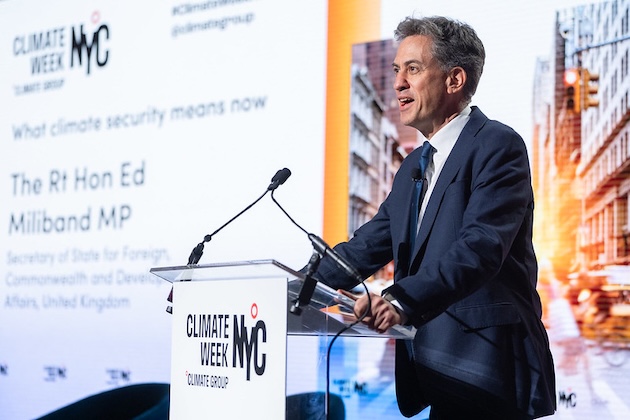 Ed Miliband, Secretary of State for Foreign and Commonwealth Affairs of the United Kingdom at Climate Week. Credit: Climate Group
Countries struggle with the overlapping consequences driven by climate change, for they are no longer confined to borders. In 2026 alone, over 150 million hectares burned in the first four months. This year has also confirmed a “super” El Niño that will likely drive global recorded temperatures and extreme weather events to new levels.
“This is why these facts, what is happening in our world, and why climate breakdown, in my view, must be an issue for foreign ministers and prime ministers, as well as energy and climate ministers,” said Miliband.
Miliband recommended governments pool information on climate issues so that it can be used to inform forecasts and early warning systems to “[act] before the crisis hits, rather than picking up the pieces afterwards.”
This sense of collective responsibility between countries was the core of the keynote speech, delivered by Australia’s Prime Minister Anthony Albanese.
“The global community cannot afford to be frozen in time while the world falls around us,” said Albanese. “Australia understands the dangers of global warming and the emergency of climate action as well as any nation. We’ve seen it up close from increasingly intense bushfires and floods.”
Albanese also spoke to the specific context of the Pacific region, where states are uniquely vulnerable to the impacts of climate change and have been among the most vocal advocates for climate action. He cited Australia’s efforts to fund and support Pacific Island states in their climate resilience plans. There is also the Pacific Resilience Facility, established last year, which he claimed was the first Pacific-led climate financing mechanism.
Adopting climate-friendly and sustainable initiatives is possible and better in the longterm to build necessary resilience. Iceland provides one such example, as a country that holds geothermal reserves but had been running on imported oil until the early 1970s during the oil crisis that disrupted their supplies. Through financing, political will, and cutting-edge technology, Iceland began developing large-scale geothermal heating districts across the country. Today, over 90 percent of households in Iceland are heated by geothermal energy. For Prime Minister Kristrún Frostadóttir, the lesson that countries should take from their example is to invest in climate-friendly infrastructure and initiatives before the next shock.
“The transition each of you is managing—in energy, in supply chains, in infrastructure, in economic competitiveness—won’t be won by the country or the company that reacts fastest to the next disruption. It’ll be won by the one that has already built the capacity to absorb it, years before it arrives. Resilience, in other words, isn’t a response. It’s a foundation you pour long before anyone tells you the storm is coming,” Frostadóttir said.
As Frostadóttir and the other world leaders remarked in their addresses, the solutions to climate change already exist. But it will require an equal measure of financing and political will to push through with the necessary steps. It cannot be a matter of waiting for the next climate or geopolitical shock to adopt those changes.
IPS UN Bureau Report



© Inter Press Service (20260922154020) — All Rights Reserved. Original source: Inter Press Service