58 minutes ago
3
58 minutes ago
3

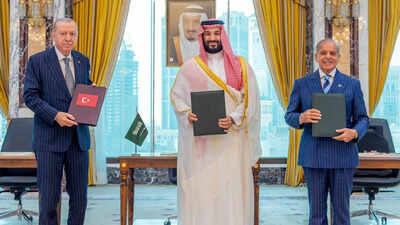
File photo: Turkish President Tayyip Erdogan, Saudi crown prince Mohammed bin Salman, and Pakistan's PM Shehbaz Sharif pose after signing a joint defence agreement in Mecca, Saudi Arabia
The foreign ministers of Turkey, Egypt, Saudi Arabia and Pakistan on Tuesday affirmed Riyadh’s right to defend itself in line with international law amid escalating attacks by Yemen’s Iran-backed Houthis, according to Reuters.Following a meeting on the sidelines of the United Nations General Assembly in New York, the ministers also stressed the need to maintain the safety of navigation in the region.The four countries expressed deep concern over the ongoing conflicts in the region and said dialogue and diplomacy were the only path to a sustainable solution.They also voiced support for Yemen’s government in its efforts to achieve stability and peace.
Regional tensions and maritime security
The joint statement comes amid heightened concerns over Houthi attacks and their impact on regional security and navigation.Earlier, Pakistan has separately described the situation around the Bab el-Mandeb strait as “exceptionally serious” and called on the Houthis to stop their activities, according to the background report.Pakistan’s foreign office has said Islamabad’s discussions on the regional situation were focused on bringing peace and stability through dialogue and diplomacy rather than coercive measures.
Pakistan defence minister Khawaja Asif has also said Islamabad remains committed to implementing its defence agreement with Saudi Arabia and Turkey.
Saudi Arabia’s defence pact with Pakistan, Turkey
The trilateral defence agreement between Pakistan, Saudi Arabia and Turkey was signed on August 7. It establishes a framework for collective deterrence and states that an armed attack against any one of the three countries would be regarded as an attack against all.The pact came under scrutiny after Saudi authorities said their air defences had intercepted and destroyed a Houthi drone south of Mecca.Saudi authorities said the drone was destroyed before entering the city’s prohibited airspace, while the Houthis denied targeting Mecca or any Islamic holy site.Asif said Pakistan would fulfil its obligations under the agreement, while also stressing that operational details would remain confidential.Pakistan’s foreign office spokesperson Sajjad Haider Khan said Islamabad remained committed to “implementing” the agreement, but added that decisions on when, how and where force could be used would remain subject to operational confidentiality.
Focus on dialogue and wider regional stability
The four foreign ministers’ call for diplomacy comes as concerns grow over the wider impact of regional conflicts on maritime routes and trade.Pakistan has said disruptions around the Strait of Hormuz and Bab el-Mandab were affecting trade and economies across the region.Turkey’s defence ministry has also said the continued Houthi threat in the Red Sea and Bab el-Mandeb was negatively affecting regional security, international maritime trade and global stability.The ministers, meanwhile, backed Yemen’s government in its efforts to achieve stability and peace and reiterated that dialogue and diplomacy were needed for a sustainable regional solution.