
 7 months ago
65
7 months ago
65

Robbie MeredithEducation and arts correspondent, BBC News NI

 Getty Images
Changes are proposed to several aspects of NI education
Fewer schools and "cashless" school meals are included in a five-year plan to reform education in Northern Ireland.
Changes to home-to-school transport, special educational needs (SEN), and the way some teachers are employed are also being proposed by Education Minister Paul Givan.
The reform plans, drawn up by the Department of Education (DE), will be presented to the Northern Ireland Assembly and Executive for approval.
Givan told BBC News NI he "wouldn't want to take forward" some of the proposed measures, but they would be necessary if his department was not given more money when the executive agrees a budget.
What big changes in education are being proposed?
BBC News NI has spoken to a number of sources for detail on the specific proposals.
There are five main areas of reform.
Some of the proposed changes to support for children with SEN are likely to be most controversial.
A recent review of Northern Ireland's education system recommended fewer classroom assistants be employed for children with SEN.
"Existing methods of supporting children and young people with special needs should be evaluated with a view to disseminating good practice and reducing the current over-reliance on classroom assistants," it said.
Fewer schools are also likely to be needed in future as the number of children of school age declines.
According to DE's own population projections, pupil numbers in schools are expected to fall by over 12% over the next decade.
As a result, the proposed changes include restructuring the school estate, which would mean more school closures or mergers in some areas.
 Getty Images
All meal payments by pupils are likely to be cashless
In the Republic of Ireland, under a redeployment scheme, teachers can be moved to work in a different school if their own school has too many teachers.
BBC News NI understands that a similar scheme is planned for Northern Ireland.
It would mean that schools who are in financial deficit could find some of their teachers redeployed to work in another school in the surrounding area if it was deemed necessary.
That would reduce their staff costs.
Under the reform plan, all meal payments by pupils are likely to be cashless, which is already the case in some schools.
There are likely to be fewer school kitchens with the creation of 'super kitchens', where a kitchen in one school supplies meals to some surrounding schools.
This happens in some areas already.
Home-to-school transport is also likely to face reform, with changes to who is judged eligible for free transport to school.
Are the measures intended to save money?
 PA Media
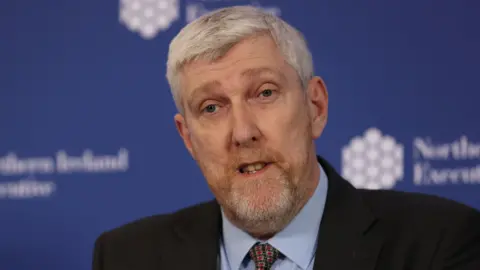
Finance Minister John O'Dowd recently published a draft budget
O'Dowd said he was "in listening mode" if other ministers had alternative proposals.
They have been told to restrict the appointment of new staff and limit the use of substitute teachers to save money.
Though some are likely to prove controversial and they would have to get agreement from other ministers in the Stormont Executive.
' Needed to create financial sustainability'
Speaking to BBC News NI ahead of the presentation of the proposals at Stormont on Wednesday Givan said the plans will go out for public consultation.
But he stressed his department was asked to produce a five-year plan by the Department of Finance in light of O'Dowd's draft budget.
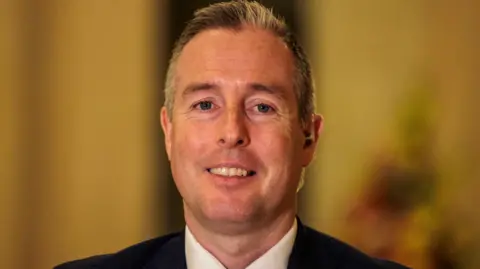
"There are some measures on this that I wouldn't want to take forward," Givan said, adding that he had to respond to a draft budget he "didn't support".
"The public will have their say, stakeholders will be able to respond to this," he said, but added that these proposals are what is needed to be considered "if we are to create financial sustainability" within education.
 PA Media
Paul Givan says some measures on this that he does not "want to take forward" but says budget constraints mean they must be considered
Givan said if more money is allocated to his department when the executive agrees a budget, then some of these measures will not need to be implemented.
"No decisions have been taken by me, but I am in a situation where I am already facing a £250m deficit this year," Givan said.
"That will rise next year to £0.9bn and will increase further in the following financial year by over £1bn."
SEN proposals give 'greater flexibility' to schools
On any potential changes to SEN in schools, Givan said that five years ago his department was spending £250m a year on SEN, but last year it spent £715m, adding that even with the additional spending, "that outcome has not been what it should be".
"I have listened to countless principals who have said there is a better way to support children and to support other children within their school.
He said: "We could give a dedicated special educational needs budget directly to schools.
"They can allocate expenditure to meet that need – that may be classroom assistants, it may be employing an additional teacher and having a smaller class setting, it could be the addition of a youth worker, counsellor, or speech and language therapist.
"I think we need to give greater flexibility to our schools so that expenditure is more effective than what it currently has been."


