5 months ago
35
5 months ago
35


 Getty Images
Free university tuition and more generous benefits in Scotland may have to be reconsidered as the country's funding advantage relative to England narrows, a think tank has suggested.
The Institute for Fiscal Studies (IFS) warned the government would struggle to pay for its flagship policies unless it finds ways to increase tax revenue and improve public service delivery.
The think tank found higher funding relative to England was the main factor allowing Scotland to have more generous public services, including smaller class sizes and free personal care services.
However, it said the funding advantage had decreased considerably in recent years.
The economists found the Scottish government received 26% more per resident for devolved public services than was spent on comparable services in England in 2024-25.
That is down from 32% in 2019–20, with the figure forecast to drop to 23% by 2028-29.
The IFS said the narrowing gap was a result of the normal operation of the Barnett formula - which is designed to allocate the Scottish government a population share of UK government spending in England - rather than a deliberate UK policy to cut funding.
The IFS said the "Barnett squeeze" coincided with an overall funding increase of 2% per year in real terms since 2019-20, following years of decreases in the 2010s.
In the current financial year, Holyrood funding for day-to-day spending is expected to be about 11% higher per person than it was in 2019-20, according to the think tank.
The IFS said the rise was "not inconsiderable", though it noted it was lower than an equivalent funding increase in England.
The economists warned of a "sharp slowdown" in funding growth in the coming years, and said that funding for public services in Scotland was currently forecast to be flat in real terms by 2028-29.
Scotland has used its devolved powers to set up a distinct tax system, which helps fund a more generous social security support and free university education.
However, the report found that to continue to fund such policies, the Scottish government will have to raise tax revenues - either by raising rates or boosting economic performance - and improving efficiency in public services. Otherwise, the IFS said, ministers would have to make cuts.
It said tax rises for higher-income Scots were the biggest contributor to an increased Scottish budget, but added that revenues had been hampered by slow wage growth and behavioural changes in response to hikes.
Martin Brogaard, research economist at IFS and co-author of the report, said: "Scotland currently enjoys more generous public services than England, in large part because the Scottish government receives around 26% more funding per person than is spent on comparable services in England.
"But after growing during the 2010s, this funding advantage is now shrinking as the so-called 'Barnett squeeze' bites.
"Without substantial increases in devolved revenues, improvements in public sector efficiency or cuts to other spending, it will be increasingly difficult for future Scottish governments to continue to provide a wider range of free services - such as university tuition and personal care - than their counterparts elsewhere in the UK."
The IFS said the Scottish government would face tough trade-offs in future budgets.
Director Helen Miller said: "Cuts to some taxes or increases in spending on priority items are feasible but will require tough choices elsewhere in a Scottish budget which will already be under some strain."
 Getty Images
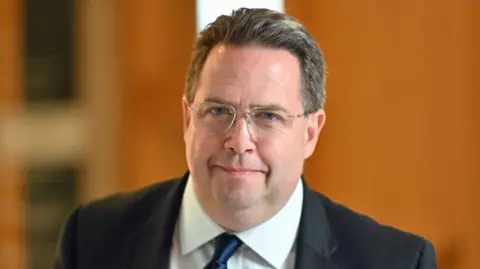
Craig Hoy from the Scottish conservatives criticised the Scottish government's handling of finances
Scottish Conservative finance spokesman Craig Hoy said: "This is a grim warning about what lies ahead for Scottish taxpayers thanks to the SNP's dire financial mismanagement."
He added: "John Swinney's SNP government has been spending like a drunken sailor and clobbering hard-working Scots with the bill, but they have finally run out of road."
A Scottish government spokesperson said its tax and spending decisions "mean that we can support vital public services and provide free tuition, prescriptions and the Scottish child payment to help tackle child poverty".
They added ministers were committed to "maximising opportunities for economic growth, embedding a strategic approach to tax and reforming our public services".