5 months ago
33
5 months ago
33

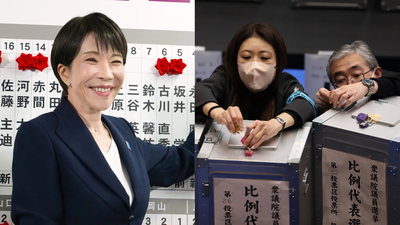
Japan’s ruling Liberal Democratic Party (LDP), led by Prime Minister Sanae Takaichi, is on course to win Sunday’s snap election by a landslide, according to projections.The conservative leader is expected to deliver 316 seats of the 465-seat lower house to the LDP — the party’s best-ever result.
Together with coalition partner Japan Innovation Party (Ishin), the ruling bloc controls 352 seats, giving it a commanding majority in parliament.NHK figures show Ishin is expected to secure 36 seats, while opposition parties won a combined 113 seats.Once officially confirmed, the result will give Takaichi wide scope to push through her conservative agenda. With a two-thirds majority, she would also be in a strong position to pursue her long-held aim of revising Japan’s pacifist constitution.
If the coalition secures at least 261 seats — a threshold known as an “absolute stable majority” — it can control parliamentary committees, easing the passage of legislation, including key budget proposals.A supermajority of 310 seats would allow the coalition to override the upper house, where it currently does not hold a majority.If the polls prove wrong and she loses her lower house majority, Takaichi has said she will resign.
Takaichi, 64, called the snap election to capitalise on her strong personal approval ratings after taking over the leadership of the long-dominant LDP late last year. Hugely popular with voters, she nonetheless leads a party that has governed Japan for most of the past seven decades but has recently struggled with funding irregularities and religious-linked scandals.She dissolved parliament just three months into her tenure, hoping to secure a fresh mandate and stabilise the party before her popularity began to wane — making the election a high-stakes political gamble.Speaking in a television interview as results came in, she said, “This election involved major policy shifts — particularly a major shift in economic and fiscal policy, as well as strengthening security policy.”“These are policies that have drawn a great deal of opposition ... If we have received the public's support, then we truly must tackle these issues with all our strength.”
LDP’s revival under Takaichi
The projected victory marks a sharp contrast with the LDP’s recent troubles.
Under Takaichi’s two predecessors, the party lost its parliamentary majority amid corruption scandals and rising living costs.In 2024, the LDP lost its majority in both houses of parliament, and its decades-old coalition with Komeito collapsed. In this election, Komeito joined forces with the Constitutional Democratic Party of Japan to form the largest opposition bloc in the lower house.Despite facing a more unified opposition, Takaichi’s personal popularity appears to have revived the party’s fortunes, with government approval ratings mostly hovering above 70%.
Far-Right presence still marginal
The far-right Sanseito party fielded a record 190 candidates and was expected to increase its presence in parliament. Opinion polls suggested it may win around 15 seats, up from just two.The gains would build on last year’s upper house election, when the party broke through with fiery warnings about foreigners and attracted notable support from younger voters.Sanseito has sought ties with US President Donald Trump’s MAGA movement.
While it is expected to remain a small party, its emergence has helped shift Japan’s political discourse to the right, a trend seen in other advanced democracies.
Who is Sanae Takaichi?
Japan’s first elected female prime minister, Sanae Takaichi is an ultraconservative leader known as much for her hardline views as for her distinctive personal style. A self-described admirer of Margaret Thatcher, she has long aspired to be Japan’s “Iron Lady,” pledging to “work, work, work” after taking office in October.A staunch conservative, Takaichi opposes same-sex marriage, legislation allowing married couples to use separate surnames, and the idea of women succeeding to the imperial throne. She has consistently backed more traditional roles for women in society and family life, despite becoming a symbol-breaking figure herself.Strongly pro-defence, she is focused on maintaining a close alliance with the United States while strengthening Japan’s own military capabilities.
She has struck up a notably warm relationship with US President Donald Trump, meeting him just days after assuming office.A motorbike enthusiast and heavy metal drummer, Takaichi has become a pop-culture phenomenon, particularly among young voters. Her appeal is driven as much by her image as her policies, with personal items and catchphrases going viral and a massive following on social media, even as critics point to her limited promotion of women within her cabinet.
China tensions grow under Takaichi
Relations with China — Japan’s largest trading partner — have become increasingly strained after Takaichi suggested last November that Japan could intervene militarily if China attempted to seize self-ruled Taiwan by force.Seen as a China hawk even before taking office, Takaichi made the remarks barely two weeks into her premiership, reinforcing concerns among voters already uneasy about her push for sharply higher defence spending.In the televised interview, she largely sidestepped questions about how soaring military outlays would be funded or how her government plans to ease diplomatic tensions with Beijing.Analysts say her rightward shift is unlikely to fundamentally alter Japan’s broader foreign policy direction. Takaichi is expected to maintain stable ties with South Korea, driven by shared concerns over security threats from North Korea and China.
A key election pledge — suspending the 8% sales tax on food — was aimed at helping households cope with rising prices. However, the promise has rattled investors concerned about how the policy would be funded, given Japan’s heavy government debt burden.Critics, including businesses, are sceptical that higher spending and tax cuts can revive the sluggish economy.One Tokyo voter, Ritsuko Ninomiya, told the BBC, “People want their lives to be better and more comfortable because we are so accustomed to not having inflation [costs rising]...
so people are very worried. I think we need a long-term solution rather than short-term fixes.”During the campaign, Takaichi pushed to toughen immigration rules, review foreign ownership of Japanese land, and tackle unpaid taxes and health insurance by foreign nationals.Critics say the policies risk creating anxiety and division in a country where only 3% of the population are foreign nationals.
Prime Minister Narendra Modi congratulated Takaichi on her “ landmark victory," saying Japan and India’s friendship could reach “greater heights.”
US President Donald Trump also congratulated Takaichi, calling her a “highly respected and very popular” leader.Writing on Truth Social, Trump said, “I wish you Great Success in passing your Conservative, Peace Through Strength Agenda.”He added, “The wonderful people of Japan, who voted with such enthusiasm, will always have my strong support.”US Treasury Secretary Scott Bessent called it a “big victory,” saying “when Japan is strong, the US is strong in Asia.” People across Japan braved snow and severe weather to vote in the country’s first mid-winter election in 36 years. The transport ministry said 37 train lines and 58 ferry routes were closed, while 54 flights were cancelled as of Sunday morning. There was rare snowfall in Tokyo as voters headed to polling stations.