6 hours ago
1
6 hours ago
1

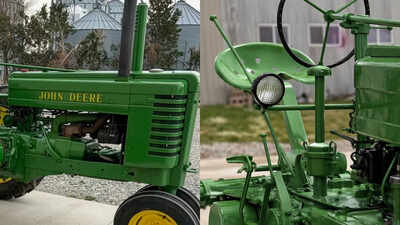
As per the online report, the Bruha family eventually sold its GM, and the tractor spent years working on another farm. Then, decades later, Bruha came across an old John Deere sitting beneath a shade tree on another Nebraska property.
Some family heirlooms sit in attics or pass quietly from one generation to the next. For Nebraska farmer Shelley Bruha, his was a 1946 John Deere GM tractor, an old machine that disappeared from the family decades ago and was eventually found rusting beneath a tree on another Nebraska farm.
What gave it away was not a serial number or a familiar paint job. It was a small modification made by his father many years earlier, after a childhood accident involving the tractor’s hand clutch, states an online report by Farm Progress. Scroll down to read the details.
A childhood lesson in leverage
According to the online report, when Bruha was young, he climbed onto his father’s open-station John Deere GM. The tractor’s hand clutch had recently been tightened, leaving the young driver without enough leverage to operate it properly.
The result was a frightening ride through a fencerow when Bruha reached the end of a field and could not slow the tractor as intended. His father responded by taking the unusual modification to a local welder.
The clutch rod was extended, giving his son enough leverage to operate the mechanism from the driver’s seat. That improvised repair became more than a practical fix. Decades later, it would become the clue that led Bruha back to his family’s lost tractor.
A wartime John Deere
The John Deere GM had its own place in American agricultural history. As per the report, introduced in 1942, during the final years of World War II, the 34-horsepower tractor was a wartime version of John Deere’s Model G. It featured electric starting and lights, a 412-cubic-inch engine and a six-speed transmission, giving it improvements over the more basic Model G. Its price was also shaped by wartime controls. The Office of Price Administration regulated the cost of tractors under the Emergency Price Control Act, limiting price increases on models that had not undergone substantial changes during the war.Production of the GM ran from 1942 through 1947, with approximately 13,000 units built. That made it considerably less common than the Model G, which saw production of roughly 64,000 units between 1937 and 1953. Rubber shortages during the war also meant some GM tractors left factories equipped with steel wheels. Later examples were fitted with rubber tires, and today the model has become a sought-after machine among vintage tractor enthusiasts.
Found beneath a Nebraska tree
As per the online report, the Bruha family eventually sold its GM, and the tractor spent years working on another farm. Then, decades later, Bruha came across an old John Deere sitting beneath a shade tree on another Nebraska property. The tractor was weathered and rusting, and there was no serial number available to immediately confirm its identity. There was, however, the hand clutch. The extended rod was a detail Bruha remembered from childhood—the modification his father had commissioned after the fencerow incident.
It was distinctive enough to connect the neglected tractor with the machine that had once belonged to his family.
Back where it belongs
Bruha eventually brought the tractor back into the family and restored it. The machine now has a life far removed from the working fields where it once earned its keep. Rather than being left beneath a tree to deteriorate, it appears at parades and plow days, where its restored form offers a glimpse into an earlier era of American farming, adds the online report. What began as a simple modification to help a child control a tractor ultimately became the identifying mark that helped reunite an aging machine with the family that first owned it.Images Courtesy: Farm Progress