3 months ago
34
3 months ago
34


 Draeyk Van Der Horn
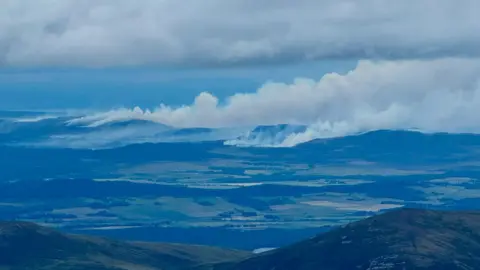
Moray councillor Draeyk Van Der Horn took this image from the Cairngorms of wildfires that broke out in late June last year
A ban on camp fires and barbecues has been introduced to the UK's largest national park in a bid to reduce the risk of wildfires.
The Cairngorms National Park Authority (CNPA), which requested the by-law, said the ban followed an "extensive" public consultation.
The national park covers 1,748 sq miles (4,527 sq km) and includes parts of five local authorities - Aberdeenshire, Angus, Highland, Moray and Perth and Kinross.
It is home to about 18,000 people and the park has about two million visitors every year.
How will the ban be enforced?
 Getty Images
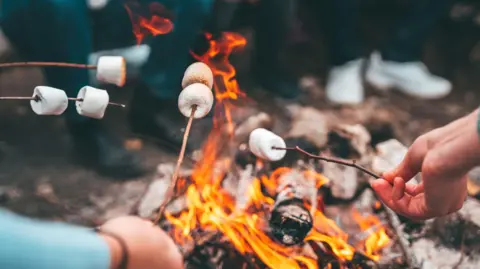
Camp fires and barbecues are to be banned between 1 April and 30 September
CNPA said it had worked with Police Scotland and the Scottish Fire and Rescue Service to prepare for "robust enforcement" of the by-law.
It said leaflets, social media messages and signage would be used to help promote the ban which will also be backed up by the power to issue fixed penalty notices.
These fines will be a maximum of £500 per offence.
CNPA said climate change had increased the risk of wildfires happening in Scotland.
Convener Sandy Bremner said: "We want people to keep enjoying all that the national park offers but we also need everyone to help protect it.
"We know it only takes one rogue spark to start a wildfire and when there is so much to lose, we can't take that risk."
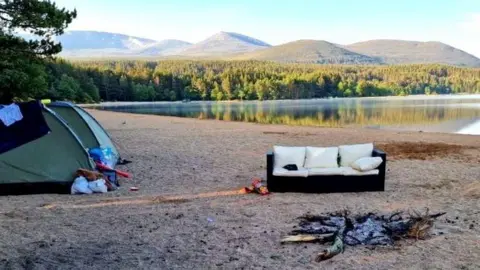
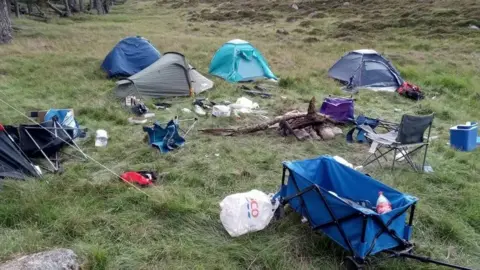
Damage caused by camp fires and anti-social behaviour has been a problem in the park for a number of years.
In 2020, rangers said revellers had left rubbish, fires and human waste after holding a "disco party" in Glen Doll in Angus.
The gathering was among dozens of incidents of irresponsible behaviour Cairngorms park rangers encountered that year.
Others included up to 30 campfires being set in one night at Glenmore near Aviemore that had to be extinguished by firefighters.
However, rangers said the vast majority of park visitors acted responsibly.
 Duncan Ferguson
 Balmoral Estate
Camp fires and anti-social behaviour have been a problem in the Cairngorms National Park for a number of years.
The ban is said to have followed "extensive" consultation on the issue.
Parts of the park in the Highlands and Moray were affected by fires that broke out in late June and early July last year.
Scottish Land and Estates (SLE) estimated the fires affected a total area of 29,225 acres (11,827 hectares) - an area almost 30 times bigger than Lanarkshire's Strathclyde Park.
The incidents at Dava and Carrbridge resulted in closures of local roads and nearby residents being told to keep windows of homes and businesses closed due to smoke.
BBC Weather Watchers reported smoke from the wildfire near Carrbridge in the Highlands drifting for 40 miles (64km) across the Moray Firth.
SFRS classifies wildfires as large, uncontrolled outdoor fires exceeding 1,000 sq m of burned area.
It says these fires are unplanned, uncontrolled and unpredictable, and occur in areas with combustible vegetation that can fuel rapid spread.
Human activity is often to blame with fires started by barbecues, glass bottles magnifying sunlight on dry vegetation and discarded cigarettes.
One of the reasons fires continued to burn on moorland was because of its peaty soil which fuels the flames.
Area Commander Robert Lennox said: "Wildfires pose a real risk to people, properties and nature.
"Each wildfire we respond to can have a significant impact on our resources and these incidents are often in remote locations, which take time to reach."
He added: "Extreme weather events are becoming more common across Scotland, and we know that communities in the Cairngorms have felt this acutely in recent years, with floods, drought and wildfires."