1 hour ago
3
1 hour ago
3

A 30-acre farm in Pennsylvania’s Bucks County has been placed under a conservation easement, creating another protected link beside the 55-acre Russell-Mandel Preserve and a wider network of roughly 1,300 acres of preserved farmland and open space.
Heritage Conservancy announced the donation on September 18, while conservation organisation WeConservePA also reported the project on September 24. The property, owned by Leah and Doug Beck, sits in Buckingham Township near the Russell-Mandel Preserve. Rather than allowing the land to become vulnerable to future development, the couple donated a conservation easement to Heritage Conservancy, permanently protecting its natural and agricultural character.
The move adds an important piece to an already connected landscape. The nearby Russell-Mandel Preserve itself covers about 55 acres and includes farmland, woodland and a tributary that flows into Pidcock Creek. Heritage Conservancy has described the preserve as part of a broader effort to protect natural and historic resources in Bucks County.
Why the trees matter
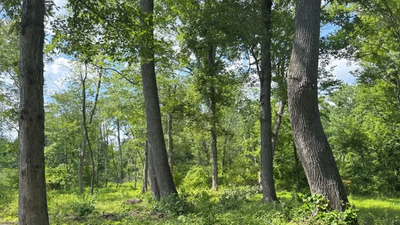
About 10 acres of the newly protected property are woodland, much of it made up of mature oak and hickory trees.
These forests do far more than provide shade. Native oaks and hickories support insects that form an important part of the food web, while their branches, cavities and dense foliage provide shelter and nesting opportunities for wildlife.According to Heritage Conservancy, the woodland can support animals including wild turkeys and roosting bats, along with hundreds of caterpillar species. The organisation’s assessment also highlights the value of the mature forest for birds that depend on established deciduous woodland.One example is the scarlet tanager, a forest bird associated with mature oak-dominated habitats. Wildlife authorities also recognise the importance of protecting habitat for species facing conservation concerns. Pennsylvania’s current Wildlife Action Plan identifies hundreds of native species as Species of Greatest Conservation Need, a designation used for wildlife facing significant threats, declining populations or other conservation concerns.
Farmland adds another layer
The protected landscape is not entirely forested. Around 18 acres of the Beck property consist of pasture and farmland, creating open habitat alongside the wooded areas. That combination can benefit grassland and open-country birds such as the American kestrel and field sparrow. Pennsylvania wildlife monitoring has recorded field sparrows and American kestrels among grassland bird species of conservation interest, highlighting the importance of maintaining suitable open habitats alongside forests.The property’s wooded areas also surround part of a tributary flowing toward Pidcock Creek. Such vegetation along waterways can act as riparian habitat while helping reduce sediment entering streams and supporting water quality.
A larger conservation corridor
The significance of the easement extends beyond the 30 acres themselves. Its location next to already protected land means the property becomes part of a larger, connected conservation landscape rather than an isolated patch of habitat.
The Russell-Mandel Preserve already supports a variety of wildlife, including turkeys, bats and American kestrels, and contains a native pollinator meadow developed by Heritage Conservancy.
The preserve’s meadow and surrounding habitats provide food and shelter for insects, birds and other wildlife.For the Becks, the conservation easement also reflects a long-standing interest in wildlife and land protection.
Heritage Conservancy said the couple, who have supported the organisation, have backgrounds surrounded by nature and have volunteered in wildlife rescue.With the easement now in place, the farm will remain part of the area’s protected landscape, preserving woodland, open fields and streamside habitat for wildlife while keeping the land connected to the much larger network around it. The Pennsylvania Wildlife Action Plan similarly emphasises protecting and managing habitat as a way to help at-risk species before they require more intensive intervention.