57 minutes ago
4
57 minutes ago
4

 Smaller generations are entering the workforce as larger generations retire and begin receiving pension benefits. Credit: Shutterstock
PORTLAND, USA, September 28 (IPS) - Dozens of government-funded pension programs providing benefits to hundreds of millions of men and women face growing fiscal strain and long-term sustainability challenges. These pressures are largely driven by rapid demographic transitions, including ageing populations, declining fertility, rising life expectancy, and shrinking workforces.
Many state pension systems rely on current workers to finance benefits for current retirees. In countries such as France, Germany, Italy, Spain, and the United States, these systems face increasing financial pressure as the number of workers supporting each retiree declines, while retirees live longer and collect benefits for more years.
Smaller generations are entering the workforce as larger generations retire and begin receiving pension benefits. This demographic shift is placing growing pressure on pension systems and raising concerns about their ability to meet future obligations.
As a result of these significant demographic changes, relatively fewer workers are paying into pension systems to support growing numbers of retirees who are living longer and collecting benefits for more years.
At the same time, extended families, local communities, and other traditional forms of support for retirees are weakening. Moreover, formal pension systems, including government-backed programs, have proven to be difficult to reform and, in some cases, financially unsustainable. In a growing number of countries, government pension programs are also facing insolvency.
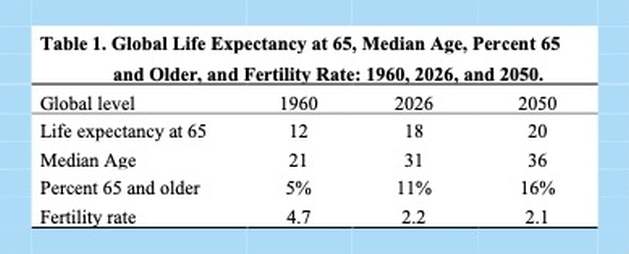
Global life expectancy at age 65, for example, has reached 18 years, a 50% increase from 12 years in 1960. At the same time, the share of the world’s population aged 65 and older has more than doubled, from 5% in 1960 to 11% today. Global fertility has also fallen sharply, from 4.7 births per woman in 1960 to 2.2 today. Moreover, these demographic trends are expected to continue well into the 21st century (Table 1).
 Source: United Nations.
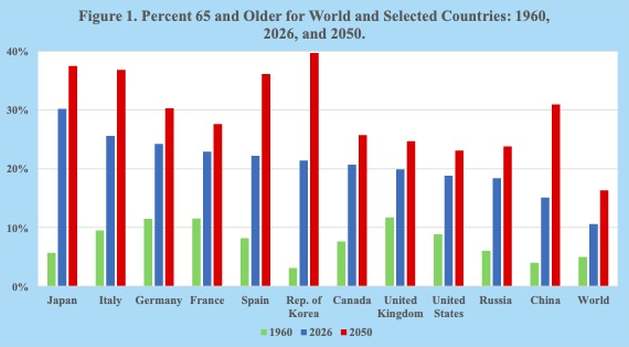
Population ageing is particularly evident in some more developed countries. For example, a quarter or more of the populations of Germany, Italy, and Japan are aged 65 and older.
Moreover, the proportion of older persons is expected to increase significantly in many countries in the coming decades. By mid-century, for example, about a third or more of the populations of China, Italy, Japan, the Republic of Korea, and Spain are projected to be aged 65 and older (Figure 1).
 Source: United Nations.
As a result of significant demographic changes in age structure, longevity, fertility, and the workforce, the number of pension beneficiaries is growing relative to the number of workers whose payroll taxes often finance these programs.
By 2050, the ratios of workers to retirees are expected to decline significantly in many of the world’s largest economies. In 2020, these ratios ranged from about 2 workers per retiree in Japan to about 5 in China. By 2050, the ratios are projected to fall to between 1 to 2 workers per retiree in these countries.
Furthermore, despite population ageing, increased longevity among older persons, and fewer workers per retiree, official retirement ages for receiving government pension benefits have remained largely unchanged.
Consequently, pension costs are projected to rise as more workers reach retirement age, while slower population and economic growth constrain the tax bases that support many of the pension programs.
As the ratio of workers to retirees worsens, government officials face difficult choices about raising retirement ages, adjusting benefits, and increasing taxes.
Countries are moving closer to the point when their pension programs may be unable to pay full scheduled benefits. Unless governments take action, pension revenues will become insufficient in many countries to cover scheduled benefits, with financial shortfalls expected to grow substantially over the coming years.
The longer governments delay necessary reforms, the larger the adjustments are likely to be to close these financing gaps. Such adjustments could involve changes to revenue, benefits, retirement ages, or other program provisions.
Despite repeated warnings from pension officials and approaching financial shortfalls, pension reform has received relatively little government attention. Policymakers have generally avoided proposing comprehensive legislation to ensure the long-term financial solvency of their pension programs.
The growing pension peril underscores the urgency of addressing these financial challenges well before programs reach their projected insolvency dates. Acting sooner would give policymakers more time to make gradual changes and restore long-term financial balance.
As some countries have done in the past, governments could establish national commissions to examine the long-term finances of their pension programs. These commissions could develop recommendations and present them to government officials well before projected insolvency dates, giving policymakers adequate time to consider and implement reforms.
Governments have several options for addressing expected pension shortfalls. Policymakers could eliminate or raise the ceiling on earnings subject to payroll taxes, increase payroll tax rates paid by employers and employees, reduce cost-of-living adjustments for high-income beneficiaries, and gradually raise the retirement age as life expectancy increases.
Many of these measures, however, are politically difficult and unpopular with much of the public. Some countries, for example, are considering raising their official retirement ages, but such proposals are opposed by large proportions of the public.
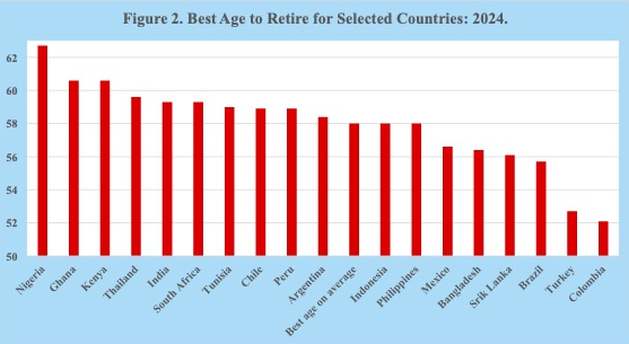
Opinion surveys also indicate a preference for lower retirement ages. For example, respondents in 18 mostly middle-income countries say, on average, that the best age to retire is around 58 (Figure 2).
 Source: Pew Research Center.
In sum, many national pension systems are in peril. Significant demographic changes – especially population ageing, increased longevity, declining fertility, and shrinking workforces – are placing growing financial pressure on many government pension programs and threatening their long-term sustainability.
Despite these well-known challenges and the prospect of growing financial shortfalls, government leaders have shown limited willingness to make the difficult policy choices needed to address them. Unless policymakers act, many national pension programs could face serious funding gaps, potentially leading to significant reductions in scheduled benefits for retirees and other beneficiaries.
Joseph Chamie is a consulting demographer, a former director of the United Nations Population Division, and author of many publications on population issues.
© Inter Press Service (20260928140121) — All Rights Reserved. Original source: Inter Press Service