57 minutes ago
5
57 minutes ago
5

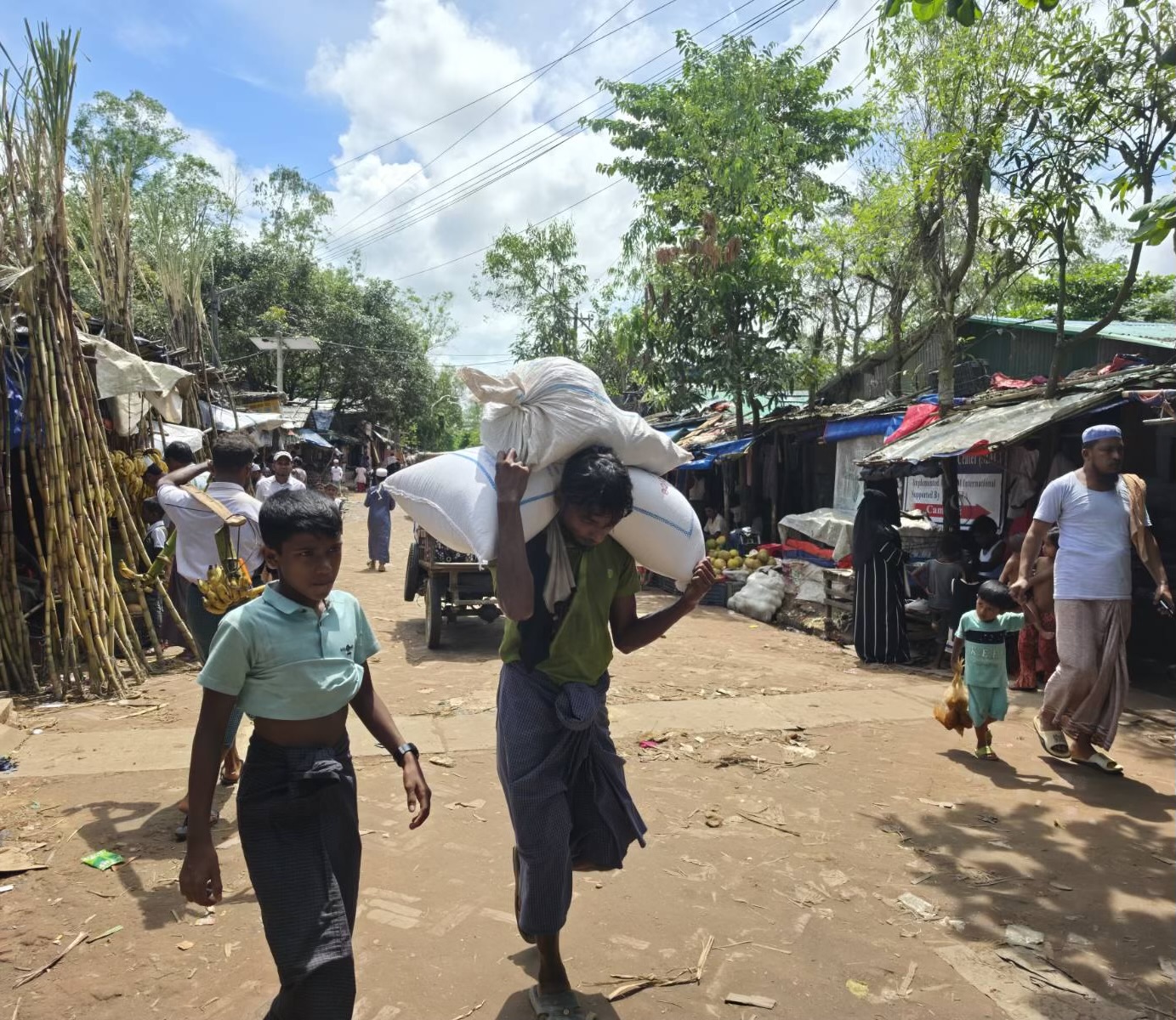 A man carries his family’s food ration from a WFP distribution point to his shelter in Camp 11, Balukhali, Bangladesh, on September 24, 2026. Credit: Mohammed Zonaid/IPS
COX'S BAZAR, Bangladesh, September 28 (IPS) - For Mohammed Dullah, recent cuts in UN food rations for Rohingya and other refugees in Bangladesh are not just spreading hunger but also forcing them to save on basic needs such as schooling and healthcare for his children.
“I was able to manage with my children somehow when I used to get $12 by going to work sometimes,” said Dullah, 59. “But since the reduction to seven dollars [per family member] a month, I can’t afford lots of basics anymore, like clothes, tuition fees, meat, or fish one or two times a month.”
As a result, his 15-year-old son has had to give up school to work in a market where he can earn about 6,000 taka ($49) a month to help sustain their family of nine.
Since April, food assistance has been allocated under a revised Targeting and Prioritisation Exercise (TPE) introduced by the World Food Programme (WFP). Households among the nearly 1.2 million refugees in Cox’s Bazar and Bhasan Char receive different levels of monthly food rations based on categories of assessed vulnerability.
WFP says the new system sets food aid at $12, $10 or $7 per person per month, depending on the household’s level of food insecurity. With money provided through UNHCR registration cards, families buy food from designated WFP e-voucher outlets.
Refugees limit what they eat and trade any surplus food for money to spend on healthcare, education, transport outside the camps and other necessities. For families with no access to formal employment, which is prohibited in the camps, even a relatively small reduction can result in making difficult choices.
Humanitarian agencies are warning that global funding cuts are driving up hunger levels. Children make up more than half of the refugee population in Cox’s Bazar.
“Conditions in the world’s largest refugee settlement are worsening at an alarming rate after nine years, with 35% of Rohingya refugees in Bangladesh expected to face ‘crisis’ or ‘emergency’ hunger levels this year, putting more children at risk of malnutrition,” Save the Children stated on August 25.
“Global humanitarian funding cuts, compounded by the resulting reductions in food rations over the past year, have exacerbated existing challenges which include overcrowded living conditions and limited access to clean water, nutritious food and livelihoods.”
A System Under Pressure
The Rohingya have been displaced from Myanmar over decades, with major waves of refugees arriving in Bangladesh in 1991–92 and again after the military-led violence of 2017. More recently, people have fled renewed violence in Rakhine State between the Myanmar military and the Arakan Army (AA), an ethnic armed organisation.
Nearly a decade after the 2017 mass exodus, many Rohingya families remain fully dependent on humanitarian assistance. Bangladesh restricts refugees’ access to formal employment, while humanitarian organisations provide food, basic informal education, basic healthcare, water, sanitation and other essential services.
International funding has come under increasing pressure. The UN and its partners have appealed for $710.5 million under the updated 2026 Joint Response Plan (JRP) to support Rohingya refugees and host communities, its lowest level in a decade. So far this year it is 50 percent funded.
WFP’s new assessment found that all Rohingya refugees were food insecure, but that severity differed between households. Households are newly classified into three categories: extremely food-insecure households receive US$12 per person per month, highly food-insecure households receive $10, and food-insecure households, which make up almost 70% of the total, receive $7.
The system is intended to allocate assistance according to need rather than simply impose a blanket reduction because of funding shortages.
WFP says that even the lowest level of assistance is sufficient to meet minimum food needs. But families and INGOs in interviews with this reporter describe a more complicated reality.
Dullah says he is unable to work because of a long-term illness, but his household was categorised at the $7-per-person level. According to Dullah, the family receives basic food items, including rice and cooking oil, but they have little left over to obtain other foods or meet other expenses.
As with other Rohingya refugees, Dullah has no legal access to paid employment, but the levels of food they receive force them to work.
“You cannot expect people to become self-reliant while preventing them from earning a living. If WFP and other agencies want us to rely more on ourselves, they also need to support legal opportunities for Rohingya refugees to work and earn an income,” he said.
“Even before, we struggled with not having enough food when we got $12,” said Dullah, who worries about his children’s growth development. His 18-month-old granddaughter needs infant formula because her mother, lacking in food, struggled to meet the child’s needs by natural feeding.
WFP essentially categorised households according to their composition.
For example, the Extremely Food Insecure bracket includes those headed by a child or by a person with disabilities, female-headed households without an able-bodied adult man aged 18–59, elderly-headed households without an able-bodied adult man, households with two or more persons with disabilities, and one-member households.
The main category of food insecurity covers male-headed households with able-bodied men and no members with disabilities, female-headed households with an able-bodied man and no members with disabilities, and households without females aged 18 to 49 or without members with disabilities.
Selling Food to Pay for Other Needs
Sawyedul Amin, 34, receives assistance valued at $10 per person for his household living in Lambashia Camp in Kutupalong. They fled Myanmar in 2017, losing their father on a mountain along the way.
He has two young children, a sick mother and a wife who has undergone two operations, one related to childbirth and another for a tumour.
“If we want to eat fish or meat, we cannot afford it,” he said. “We also have small children, which means we have additional expenses for them. I also have an ill mother, which makes our medical expenses even greater.”
Sawyedul said he sometimes sells part of his family’s food allocation to obtain cash for those expenses.
Selling or trading food for medicines or services is nothing new in the camps, and the impact has been well documented in earlier cuts.
In 2023 funding shortages forced WFP to reduce monthly food rations from $12 to $10 and then further to $8 in June that year. Monitoring found deteriorating food consumption and worsening nutrition indicators.
Sawyedul said other organisations previously sometimes provided his family with additional assistance, but some of that support has declined. “We now have only the WFP to look to for assistance,” he said.
Flaws in the Rationing System
Radia Bala, a 60-year-old widow among a refugee community of about 1,000 Hindus, had to survive with no assistance at all for five months this year. Her family, along with many others, eventually started to receive aid in July.
Radia, from Nakpura village in Myanmar, arrived in Bangladesh with her family in 2024 after fighting between AA insurgents and the Myanmar military spread through her area.
She recalls ground and air attacks, homes burnt down, and relatives and neighbours killed around her. The insurgents also targeted them for forced recruitment. Their escape involved a three-day journey, partly through mountains.
After reaching Bangladesh, Radia says her family received a smart card and initially received food assistance, cooking gas and soap. But then it stopped in December 2025. “I wasn’t given an exact reason by the authorities why it was stopped,” she said.
Radia now rents space in the house of a local Bangladeshi family from the Barua ethnic group. She is among nearly 150,000 newly arrived refugees who have not been provided with shelter, having crossed from Myanmar’s Rakhine State between December 2024 and March 2026.
Radia and her daughter, who has a six-month-old baby, work as cleaners to survive. “During those months [with no food aid], we ate only rice with leafy vegetables,” she said. When assistance was available, she said, the family could sometimes eat chicken, eggs and bananas.
Her experience highlights serious flaws in the system of allocating food rations, namely that access depends on registration and connection to the mechanisms through which it is delivered.
Radia says that when people from her community arrived in 2024, they were told that food assistance would be available if they stayed inside the camps. But she says the family found it difficult to remain there because of shortages of shelters, water, toilets and washrooms.
“We stayed in the camp for about a month in a relative’s shelter, but life there was very difficult,” she said.
Her family subsequently moved between relatives’ homes and other temporary locations. “We have been living from place to place, staying on the streets and in other people’s homes.”
After raising complaints and following media coverage of their plight, she started receiving $12 per person. But Radia says she needs to sell half of that to pay for room rent.
Her request is simple. “Our first need is food assistance, and our second need is shelter,” she said.
WFP says it provides monthly food assistance to all the refugee population, including people who arrived after 2024, according to their assessed need.
Risks for Children are Worsening
Golam Mostofa, head of Save the Children’s Cox’s Bazar Area Office, said children are increasingly exposed to risks as families struggle with limited resources and opportunities.
“The situation is getting worse day by day,” he said.
Child protection monitoring had raised increasing concerns over child labour and child marriage, as well as other risks facing children and adolescents, he added.
However, Mostofa cautioned against assuming that every reported case of child labour, child marriage, malnutrition or dropping out of NGO learning centres was caused by the latest food-assistance changes.
However, Save the Children’s current assessment warns that worsening access to nutritious food, healthcare and other essentials is increasing pressure on children.
The NGO predicts that by the end of this year, some 10 percent of refugees in camps in Cox’s Bazar will fall into Phase 4 of the international classification of “humanitarian emergency”, which is defined as leading to frequent deaths and increasingly high rates of malnutrition. This is defined as one step before famine and humanitarian catastrophe.
Mostofa appealed to donors to continue supporting food, education, healthcare, water and sanitation while also expanding opportunities for skills development and safe livelihoods.
The WFP Bangladesh communication team did not respond to requests for comment.
Refugees Face Dangerous Choices
While Save the Children has been working in Cox’s Bazar since 2012 with programmes for education, healthcare, water and sanitation and child protection, a whole generation of Rohingya children has grown up in camps which began as emergency settlements but have turned into long-term places of residence.
For families with limited access to formal employment, humanitarian assistance remains central to daily life. Continued civil war in Myanmar, driven by an entrenched military regime backed by China, provides little prospect of a durable solution that would allow the mostly stateless Rohingya to return to their homes.
Committing their lives to human traffickers and fleeing Bangladesh by sea in search of a better life is extremely perilous. An estimated 5,000 refugees are believed to have perished over the past decade while attempting to reach other countries in Southeast Asia.
Dullah still talks about returning to Myanmar, remembering the land he farmed and the cows and buffaloes he owned before his family were forced to flee in 2017. “I want to be able to return and rebuild my life,” he said.
As world leaders met in New York for the UN General Assembly, Bangladesh Prime Minister Tarique Rahman called for a clear roadmap for the safe, voluntary, dignified and sustainable return of Rohingya refugees to Myanmar, alongside continued humanitarian support, protection of civilians and international accountability.
Until that becomes possible, refugee families like Dullah’s remain dependent on an aid system based on calculations of dollars per person, while the choices they face are measured in meals, medicines, school days and the future of their children.
Note: This story was produced with support from Moving Minds Alliance (MMA) through the Reporters for Early Childhood in Humanitarian Crisis (REACH Network) Advocacy Stories Fund
IPS UN Bureau Report



© Inter Press Service (20260928100513) — All Rights Reserved. Original source: Inter Press Service