3 months ago
37
3 months ago
37

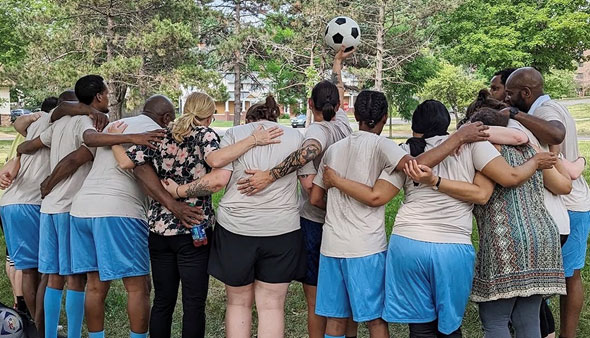 Refugees and staff from the Center for Victims of Torture play soccer and celebrate human rights, Minneapolis, USA, June 2023. Credit: CVT
PERTH, Australia, June 11 (IPS) - This planet’s biggest sporting event—the FIFA Men’s World Cup—will soon kick off. Millions of people around the world will sit up, bleary eyed, watching matches at unreasonable hours and inventing feeble excuses for why we won’t be at work in the morning. More than one billion are expected to watch the finale on TV in mid-July. That’s a bigger audience than any Olympic sporting event and more than the number of people who have viewed Squid Game on Netflix.
The World Cup is also big business. FIFA predicted the competition might bring in a whopping US$30.5 billion in tourist dollars for the United States, Canada and Mexico—the three 2026 host countries. But all is not well with the beautiful game.
Amnesty International and more than 100 local human rights organizations have issued a travel warning for fans planning to visit the eleven U.S. cities that are hosting World Cup matches. According to figures obtained by Human Rights Watch, ICE arrested 167,000 people around the eleven cities from January 2025 to March 2026. Visitors are warned they may experience invasive searches of their phones at the border, “racial profiling,” and other egregious abuses that breach “the United States’ human rights obligations under domestic and international law.” Even before the first whistle is blown, Africa’s leading referee, Omar Artan from Somalia, was denied entry to the United States at Miami International Airport and will now miss the tournament.
Tourist arrivals in the U.S. were already down 5.4% last year, with a “Trump slump” now impacting the upcoming World Cup. According to a survey of more than 200 host city hotels conducted by the American Hotel and Lodging Association, “nearly 80% said hotel bookings are tracking below initial forecasts.” Some fans are having trouble securing a visa, but spiraling expenses and the threat of being deported for some nasty comment you made about Trump on Facebook are also disincentives.
At a massive “No Kings” protest in Brooklyn last October, I joined my fellow New Yorkers to march against this democratic backsliding in the United States. At least 6 million people protested nationally, with a quarter of million in New York, where I had been working for the past decade.
The day felt like a festival. One protester was blowing a vuvuzela, an annoyingly loud horn introduced to the global community at the 2010 FIFA World Cup in South Africa. Someone else was wearing an inflatable chicken suit and carrying a sign that said, “I’m more mature than the President.”
Despite the frivolity, President Trump had threatened to deploy the FBI against protesters, and his team denounced the No Kings movement as being manufactured by treasonous malcontents. White House Press Secretary Karoline Leavitt blamed the Democratic Party and claimed, “its main constituency are made up of Hamas terrorists, illegal aliens, and violent criminals.” The No King’s website, meanwhile, said that “in America, we don’t have kings and we won’t back down against chaos, corruption, and cruelty.” It felt like a clash was likely.
On the day, however, the most aggressive encounter I had was when someone thrust a small bright-yellow card into my hand. It boldly declared, “Know Your Rights,” and offered helpful text to recite if you were detained, including: “The U.S Constitution grants all people rights. I am proud to be exercising mine.” A QR code linked to relevant legal advice.
Those laws still stand between President Trump and the unconstrained power he covets. But given that Trump has now appointed 265 federal judges and three Supreme Court Justices, some legal safeguards appear precarious. Some U.S. federal agencies have already embraced Trump’s authoritarian tilt, with illegal deportations and the extrajudicial killing of two protesters on the streets of Minneapolis being the most disturbing examples of a corrosive trend.
The resulting gap between jurisprudence and justice can be deadly. As president of the U.S.-based Center for Victims of Torture (CVT) I had visited safe houses in the suburbs of Nairobi, Kenya, for LGBT+ refugees from African countries where same sex relationships were illegal. Article 27 of Kenya’s constitution guarantees freedom from discrimination, but on the streets of Nairobi, many refugees remained vulnerable.
A CVT colleague recently texted to inform me that a LGBT+ refugee from Somalia had been murdered. She was in Kenya awaiting legal resettlement to the United States but had been halted by Trump’s ban on refugee admissions. In Kenya, like any other country, the laws that secure people’s rights are only ever as strong as the willingness of police, courts, and parliaments to uphold them.
Only around a dozen countries in the world have comprehensive national human rights laws, enacted by parliament and grounded in international treaties and conventions. These include South Africa, India, Ireland, as well as Canada, New Zealand and the United Kingdom. Many other states—including Brazil, Japan, United States and Kenya—protect some fundamental rights and freedoms through their constitution or a bill of rights. Australia is the only major liberal democracy in the world without either a national human rights act or a bill of rights, although there is growing domestic pressure to rectify that perilous legal shortcoming.
The World Cup has already given a lot to global culture. Think not just of the insufferable vuvuzela, the embarrassing macarena and the irrepressible Mexican wave. Its deeper value might be in reminding us that in these times of creeping authoritarianism, all states should strengthen their human rights protections.
Simon Adams is Professor of Human Rights, Murdoch University, Australia
IPS UN Bureau
© Inter Press Service (20260611073836) — All Rights Reserved. Original source: Inter Press Service