4 months ago
31
4 months ago
31

Natalie ShermanBusiness reporter

 Getty Images
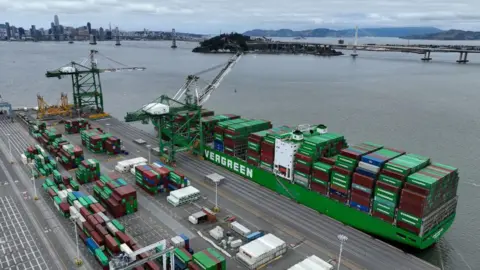
US goods imports continued to outpace its exports last year, sending the country's trade deficit to a new high despite sweeping tariffs introduced by US President Donald Trump.
The gap between the value of goods imported into the US and American products sold to other countries widened by 2.1% compared to 2024, hitting roughly $1.2 trillion (£890m), official figures show.
The rise emerged despite a sharp drop in trade with China, one of the earliest targets of the tariffs.
The gap runs counter to one of the White House's key aims which is to reduce the deficit, arguing that US reliance on overseas goods has hollowed out the country's production abilities and put national security at risk.
Last year, Trump introduced tariffs of at least 10% on goods from nearly every country in the world.
At the time, he said the new taxes on products coming into the US would help boost local manufacturing and make it easier for American firms to sell abroad.
The measures - which in some cases were much higher than before trade deals were struck - sparked widespread turmoil for businesses and global economies.
But while trade flows swung wildly, they did not stop.
Imports of goods - some of which US firms had rushed at the start of last year to get ahead of Trump's tariff regime - reached a record $3.4tn, according to the Bureau of Economic Analysis.
Business investment in artificial intelligence helped drive demand, as US imports of computer parts and equipment surged.
Exports also hit a new high, despite a drop in shipments of US food, cars and car parts, two of the sectors most exposed to the trade changes.
US trade with China, including imports and exports, fell to reduce the deficit by roughly 30% to $202.1bn. This was the smallest deficit for around in two decades.
But the US still recorded record trade gaps with several countries, including Mexico, Vietnam and Taiwan.
Overall, the deficit in goods and services - which takes into account things like travel and digital services - was $901.5bn last year, almost unchanged from $903.5bn in 2024.
The White House has said it will take time for its efforts to pay off.
But Trump's frequent revisions to the tariffs have raised uncertainty about the strategy.
The president has used the threat of tariffs during international negotiations. Most recently, he signed an executive order stating the US would impose additional taxes on countries that continue to trade with Iran.
The Supreme Court is also currently weighing a challenge to the duties brought by a group of businesses and states, which could lead to the bulk of last year's tariffs being struck down.
If the Trump administration loses the case, White House officials have said they are prepared to reinstate the tariffs using different tools.
"Looking ahead there will inevitably be more rejiggering in supply chains, but we see scope for a modest ascent in imports in spite of tariffs in the year ahead," analysts at Wells Fargo wrote in a report on Thursday.