1 hour ago
2
1 hour ago
2

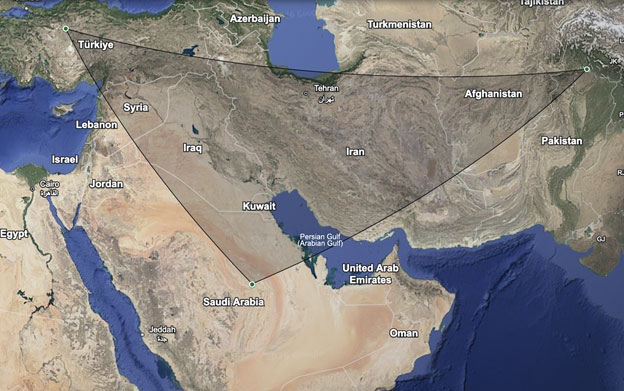 Geography of the Makkah Defence Agreement, illustrating the strategic triangle formed by the capitals of the three signatory states—Ankara, Türkiye, Riyadh, Saudi Arabia, and Islamabad, Pakistan. Credit: Maximilian Malawista
UNITED NATIONS, August 11 (IPS) - In Makkah, the Kingdom of Saudi Arabia, the Republic Türkiye, and the Islamic Republic of Pakistan agreed to the framework for a joint defence agreement where an attack on any of the three states shall be regarded as an attack against them all.
The agreement, signed on August 7, comes as Saudi Arabia is regularly attacked by Iranian strikes or proxies. Under the agreement, such attacks could fall within the pact’s collective defence provisions.
The Saudi Press Agency says “The agreement is intended to strengthen collective deterrence against any act of aggression, and stipulates that any armed attack against any one of the three states shall be regarded as an attack against them all. It further provides for the enhancement of all aspects of defense cooperation among the three states.”
Strategically, Saudi Arabia, Türkiye, and Pakistan form a triangle axis around Iran, with Türkiye and Pakistan both sharing land borders with Iran. This geographic positioning means any regional conflict involving Iran could potentially involve pressure from multiple directions, increasing the agreement’s deterrent value.
Iran, however, has played down concerns over the agreement. Iran’s Foreign Ministry spokesman Esmaeil Baghaei said Monday that Tehran sees no reason to be concerned, describing the pact as part of a broader shift toward greater regional self-reliance in security matters.
In the Strait of Hormuz, a framework is reportedly in its final stages to be signed as Iranian and Omani delegations finalize a proposed “temporary” commercial shipping agreement, aiming to allow traffic to resume flowing through the Strait.
“This understanding does not signify a full reopening of the Strait of Hormuz; rather, it represents a new model—distinct from the practice of the past sixty years—under which a significant portion of the shipping route will pass through Iran’s territorial waters,” said Kazem Gharibabadi, Deputy Foreign Minister for Legal and International Affairs of Iran.
The geographic location of the proposed shipping route has been agreed upon, meaning a significant portion of commercial shipping would pass through Iranian territorial waters under the new framework.
Gharibabadi also mentioned that whether Iran would collect transit fees from vessels passing through the Strait would depend on decisions by the country’s highest authorities and on the United States’ conduct.
Baghaei has said the talks with Oman are focused on establishing a route for safe passage of shipping, but stressed that such an agreement would be a necessary, rather than sufficient, condition for reopening the Strait. The talks between Iran and Oman have been ongoing for two months, while Pakistan and Qatar are continuing efforts to reduce tensions, according to Iranian state media.
As long as the U.S. naval blockade of Iran remains in place, and what Tehran describes as U.S. military aggression continues, Baghaei said, there would be no significant change in the status of the Strait.
If implemented, the agreement could represent one of the most significant changes to commercial navigation through the Strait of Hormuz in decades, shifting portions of international shipping into Iranian shipping lanes/territorial waters, potentially giving Tehran greater influence over one of the world’s busiest energy chokepoints.
These two developments together illustrate the competing dynamics unfolding in the Gulf. While Saudi Arabia, Türkiye, and Pakistan are strengthening collective military deterrence, Iran is simultaneously attempting to reshape how global shipping and navigation occurs through the Strait of Hormuz, one of the world’s most strategically important maritime corridors.
IPS UN Bureau Report
© Inter Press Service (20260811062542) — All Rights Reserved. Original source: Inter Press Service